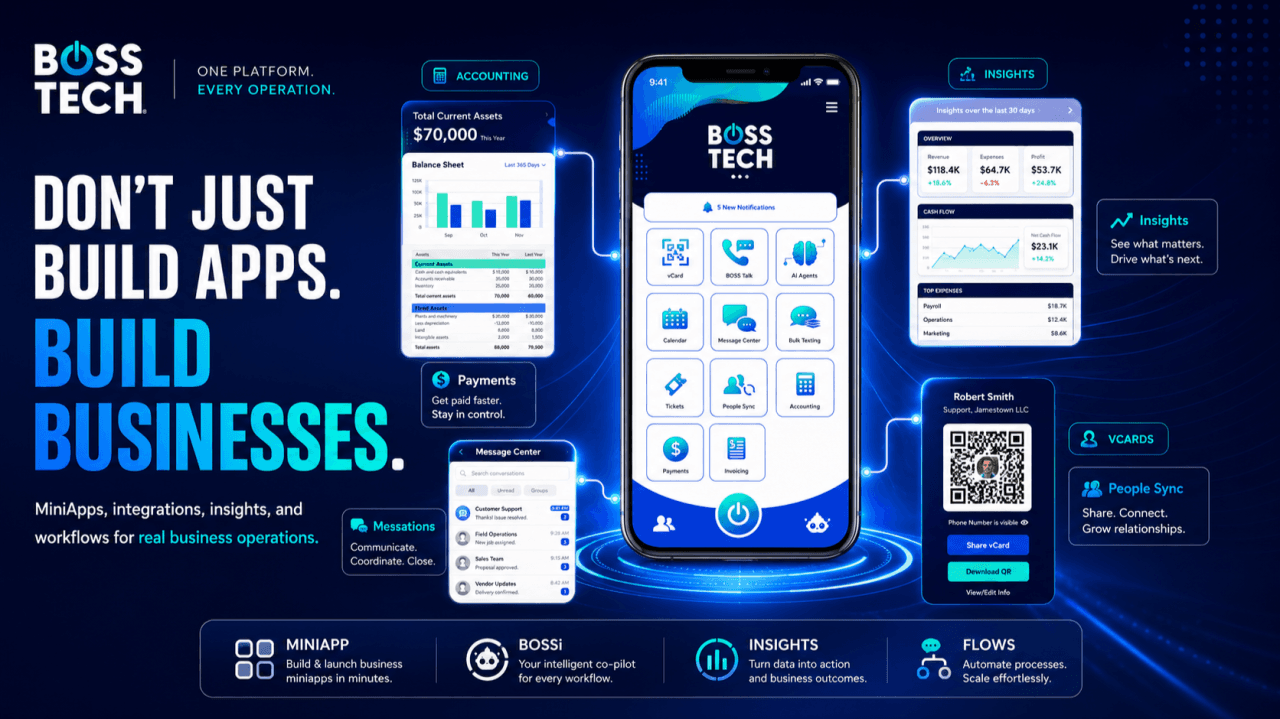
The Next Great Developer Platform Won’t Just Build Apps. It Will Build Businesses.
June 9, 2026
TL;DR
- Most developer platforms help builders create apps. BOSS.Tech helps builders create business outcomes.
- BOSS.Tech gives builders access to MiniApps, integrations, AI-powered insights, and workflow automation so they can solve real operational problems for real businesses.
- The future is not just an app marketplace. It is a builder ecosystem where developers, universities, coding communities, and partners can create reusable business solutions that help companies operate better.
Most developer platforms ask a familiar question:
What can you build?
BOSS.Tech asks a better one:
What business can you help build?
That difference matters.
The world does not need more disconnected apps.
Businesses are already drowning in software. The average company uses too many tools, too many dashboards, too many logins, too many workflows, and too many systems that do not talk to one another. Small and mid-sized businesses feel this pain most acutely because they need modern software, but often lack the IT teams, budgets, and technical support larger companies take for granted.
So the next great developer platform cannot simply help builders ship more apps into the chaos.
It has to help builders reduce the chaos.
That is the opportunity BOSS.Tech is creating.
BOSS.Tech is an AI-native Business Operating System where builders can create MiniApps, integrations, automations, and AI-powered workflows that help real businesses operate better.
This is not just a developer story.
It is a business transformation story.
And it opens the door to a new kind of builder economy.
The Problem: Apps Are Easy. Business Operations Are Hard.
Building an app has never been easier.
Builders have more tools than ever: AI coding assistants, low-code frameworks, APIs, templates, design systems, component libraries, cloud infrastructure, and open-source projects.
That is a good thing.
But here is the problem: easier app creation does not automatically create better business outcomes.
A small business does not wake up saying, “I need another app.”
It wakes up needing answers:
- Who needs a follow-up today?
- Why did revenue dip last week?
- Which customer conversation fell through the cracks?
- Where is the updated inventory?
- Which invoice is overdue?
- Why are support issues disconnected from sales history?
- What information is stuck in someone’s inbox?
- Which workflow is wasting the team’s time?
Those are not app problems.
Those are operating problems.
And operating problems are harder because they rarely live in one place.
They live across email, calendars, CRMs, spreadsheets, accounting tools, messaging systems, support platforms, social media, payment tools, inventory software, and the institutional memory of whoever has been holding the business together by force of will.
This is why so much software fails to transform small businesses.
It solves a slice, but not the system.
It gives a dashboard, but not context.
It automates a task, but not the workflow.
It adds another login, but not a better way to operate.
The next developer platform has to start from this truth:
Businesses do not need more software. They need software that understands how their business actually works.
The BOSS.Tech Thesis: Builders Should Build Around the Business, Not the Other Way Around
Most software forces businesses to adapt to the tool.
BOSS.Tech flips that.
The business should define the workflow.
The builder should be able to create around that workflow.
That is why BOSS.Tech is built as a Business Operating System, not just another app platform.
An app usually solves a specific problem.
A Business Operating System creates a connected foundation where many business problems can be solved together.
For builders, this changes the starting point.
Instead of building a standalone tool that may or may not fit into a company’s existing stack, builders can create inside an operating layer designed for business context.
That means builders can work with:
- Business data
- Existing software integrations
- MiniApp experiences
- AI-powered insights
- Workflow automation
- Reusable components
- Customer-specific use cases
- Industry-specific operating needs
This is a much bigger canvas than “build an app.”
It is an invitation to build business solutions.
The Building Blocks: MiniApps, BOSSi, Insights, and Flows
BOSS.Tech gives builders multiple ways to create value.
MiniApps
MiniApps are configurable business applications built for specific workflows, industries, communities, or customer needs.
A MiniApp might support a festival, a venue, a franchise network, a game cafe, a professional services firm, a merchant ecosystem, or a local business community.
The point is focus.
MiniApps do not need to become bloated enterprise software. They can solve a real business problem in a clean, useful, mobile-first way.
BOSSi
BOSSi is the integration and synchronization layer.
It helps connect and normalize information across the software businesses already use.
For builders, BOSSi matters because business data is usually fragmented. If builders want to create useful workflows, they need a way to bring scattered information into a more usable operating layer.
Insights
Insights brings AI-powered intelligence into business operations.
The goal is not AI theater.
The goal is practical intelligence: what is happening, what changed, what needs attention, what action should happen next.
AI becomes more useful when it has better business context. BOSS.Tech is designed to create that context.
Flows
Flow supports workflow automation and recurring business processes.
For builders, Flows is where business logic becomes action.
Instead of building a tool that merely displays information, builders can help businesses move work forward.
Together, these frameworks create the foundation for a different kind of developer platform.
Not a place to build isolated apps.
A place to build operating capability.
The Marketplace Opportunity: Builders Need Distribution, Not Just Tools
Developers do not just need APIs.
They need paths to customers.
That is where many developer platforms fall short.
They give builders tools, documentation, and maybe a showcase page, but they do not solve the hardest problem: how does a useful solution find the businesses that need it?
BOSS.Tech has a different opportunity because the platform is tied to real business ecosystems.
A MiniApp for a festival can onboard vendors and organizations.
A payments partner can introduce BOSS.Tech to merchants.
A franchisor can bring BOSS.Tech to franchisees.
A university can activate students around real business problems.
A developer community can build workflows for local businesses.
A marketplace can let builders create solutions that become reusable across industries, customers, and communities.
That is powerful because the builder does not have to invent the entire market from scratch.
The partner brings the community.
BOSS.Tech brings the platform.
Builders bring the imagination.
Customers get better software.
That is not just a marketplace.
That is an ecosystem.
Proof Point: 37 Teams and 100+ Builders Showed Up
The Build w/BOSS.Tech hackathon gave us an early glimpse of this ecosystem.
The event sold out with 37 teams and more than 100 registrants, bringing together builders, students, developers, founders, and operators to explore what could be built on a Business Operating System.
Participants had access to:
- BOSSi docs
- The MiniApp framework
- APIs
- BOSS.Tech mentors
- Ryan, Felicite, and team office hours
- Two days of training sessions before the event
This was not a generic coding competition.
It was a live test of whether builders would respond to real business problems, applied AI, workflow automation, and platform-based creation.
They did.
The winning projects showed the range of what builders can create when they start with operations, not novelty.
AI CRM, built by Afeef Allahbaksh, Muhammad Rohan Khan, and Toshan Gosain of Drexel University, explored an automated AI CRM for SMBs.
Divided by 8 by Andrew Snyder created a game cafe app that delivers members access to the cafe’s game inventory, tracks who has what, and recommends games based on player preferences.
Polyxa by S4 Collective created an Autonomous Policy Proxy, a kind of Fractional Chief of Policy that helps normalize fragmented policies and provide real-time, policy-compliant answers and actions for agile entrepreneurs.
These projects were not random demos.
They were examples of builders seeing real operational pain and imagining software around it.
That is the point.
Why This Matters for Builders
For builders, the opportunity is clear.
The future belongs to people who can do more than write code.
It belongs to builders who understand how businesses operate.
A developer who understands workflows becomes more valuable.
A designer who understands business friction becomes more valuable.
A student who understands customer pain becomes more valuable.
A founder who can translate messy operations into useful software becomes more valuable.
BOSS.Tech gives builders a platform to practice and monetize that skill.
One builder described the value beautifully:
“Just being able to pull the things that you need to serve your customers into one interface without having to go through a point of sale app to enter inventory or try to get existing software to fit your business model, to take everything you need and nothing you don't, easily, that's the best thing about BOSS.Tech.”
That is the builder thesis in plain English.
Everything you need and nothing you don’t.
Builders should not be limited to creating generic tools for imaginary users.
They should be able to create specific, useful software for real businesses with real workflows.
That is what BOSS.Tech enables.
Why This Matters for Universities and Developer Organizations
Universities and coding organizations are looking for better ways to teach applied AI.
The world has moved beyond theory.
Students and builders need to work with real problems, real constraints, real customers, real workflows, and real business context.
A Build w/BOSS.Tech program can give universities, coding communities, and builder organizations a practical way to teach:
- Applied AI
- Business automation
- Product thinking
- Workflow design
- Integration strategy
- Entrepreneurship
- MiniApp creation
- Customer discovery
- Real-world software development
This matters because AI education cannot stay trapped in prompt exercises and classroom demos.
A student should learn how AI connects to messy customer data.
A developer should understand how workflows break.
A founder should learn why business context matters.
A coding community should be able to build for real local businesses, not just toy problems.
BOSS.Tech gives these communities a platform to build on and a set of business problems worth solving.
That is why universities and developer organizations can become powerful partners.
They do not merely teach people to code.
They help people build things that matter.
Why This Matters for Businesses
For businesses, the benefit is equally important.
Small and mid-sized businesses often cannot afford custom software.
They may not have an internal IT team.
They may not know how to evaluate AI tools.
They may not have the time to stitch together yet another stack.
But they do have specific needs.
A game cafe has a specific workflow.
A festival vendor has a specific challenge.
A franchisor has a specific operating model.
A local service business has specific customer communication pain.
A nonprofit has specific coordination needs.
A payments merchant has specific reporting, messaging, and follow-up workflows.
These businesses do not need generic software advice.
They need builders who can solve specific problems with practical tools.
BOSS.Tech can connect those worlds.
Builders get a platform.
Businesses get better solutions.
Partners get stronger communities.
The marketplace gets more valuable over time.
The Next Developer Platform Builds Businesses
The developer platforms that defined the last era helped builders create apps, websites, integrations, stores, and workflows.
The next era will demand more.
Businesses are more fragmented.
AI needs better context.
Customers expect faster service.
Operators are overwhelmed.
Software stacks are bloated.
Small businesses need modern capabilities without enterprise complexity.
That creates a new mandate for developer platforms:
Do not just help builders ship software.
Help them create business value.
That is what BOSS.Tech is building.
- A MiniApp can become a workflow.
- A workflow can become a business solution.
- A business solution can become a revenue stream for the builder.
- A marketplace can become the distribution layer.
- A partner community can become the channel.
- An operating system can become the foundation.
That is a much bigger opportunity than building apps.
It is building businesses.
The Invitation
BOSS.Tech is creating a platform for builders who want to solve real problems.
Not imaginary problems.
Not demo-day problems.
Not “AI for AI’s sake” problems.
Real business problems.
The kind that show up in customer follow-up, inventory, scheduling, policy, payments, communications, vendor onboarding, franchise operations, event logistics, support workflows, and daily business chaos.
If you are a builder, BOSS.Tech gives you a new kind of canvas.
If you are a university, BOSS.Tech gives your students real business context.
If you are a coding organization, BOSS.Tech gives your community meaningful problems to solve.
If you are a developer partner, BOSS.Tech gives you a platform around which to activate your community.
If you are a business, BOSS.Tech gives builders a better way to create the tools you actually need.
The next great developer platform will not just build apps.
It will build businesses.
And BOSS.Tech is building the operating system to make that possible.
Interested in building on BOSS.Tech or bringing Build w/BOSS.Tech to your university, developer community, coding program, or builder organization?
Partner with BOSS.Tech to create applied AI, MiniApp, and business automation experiences for your community.