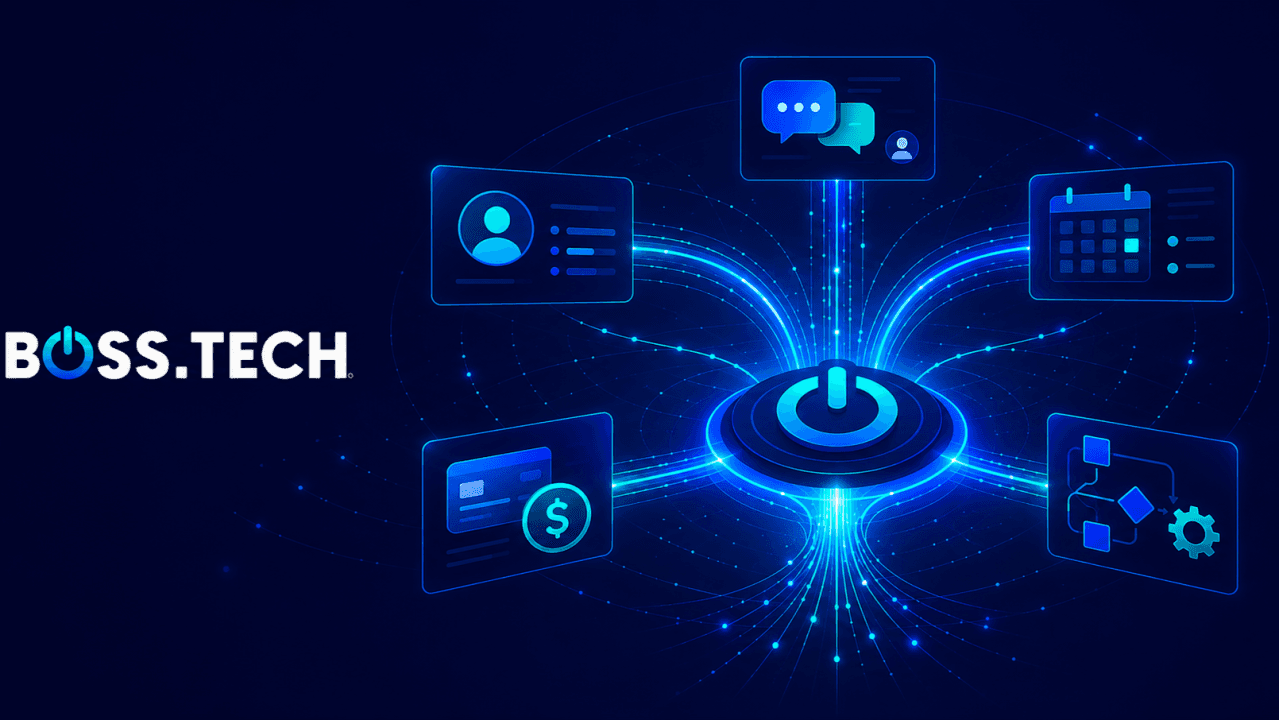
Five Barriers Holding SMBs Back from Digital Transformation, and How BOSS.Tech Helps Reduce the Friction
July 8, 2026
For small and midsize businesses, digital transformation is no longer simply about adopting more software.
Most businesses already have tools. The harder challenge is making those tools, data, workflows, and AI work together in a way that actually improves operations.
Current research shows that the gap between adoption and effective implementation is real. The OECD’s 2026 D4SME Survey found that AI adoption is rising among surveyed SMEs, but deeper, strategic integration remains uneven. The survey, based on a non-representative sample of more than 2,000 SMEs across 12 OECD countries, also found that practical constraints continue to get in the way. Among respondents, 39% cited maintenance costs, 38% cited lack of time for training, and 37% cited hardware costs as challenges to digital adoption.
The problem is not necessarily a lack of technology.
Often, it is a lack of connection.
Customer information lives in one place. Financial data lives somewhere else. Messages, calendars, workflows, and business knowledge are spread across systems that were never designed to operate as one.
For SMBs, that fragmentation creates five major barriers to meaningful digital transformation.
BOSS.Tech cannot solve strategy, leadership, or culture on its own. No technology can. What it can do is help reduce the operational friction that makes progress harder by connecting tools and data, creating more context across the business, and supporting more intelligent workflows and experiences.
Here is how.
Barrier #1: Change Feels Too Disruptive
For an SMB, change rarely happens in a controlled environment.
The business still has customers to serve, employees to manage, invoices to send, meetings to attend, and problems to solve. Teams are often already stretched thin.
That is why even a promising new technology can face resistance. The issue is not always that people are unwilling to innovate. Sometimes, the business simply cannot afford to stop operating while everyone learns a completely new system.
The OECD’s 2026 research reflects that reality. Lack of time for training was cited by 38% of surveyed SMEs as a significant obstacle to digital adoption.
How BOSS.Tech Helps
BOSS.Tech helps reduce the pressure to treat transformation as a complete reset.
Rather than assuming every business should replace everything at once, BOSS.Tech is designed to connect business tools and data into a more unified operating environment. Its platform architecture supports services that normalize and synchronize data across integrations, creating building blocks that can support broader business experiences.
For an SMB, that creates a more practical path forward.
The goal is not to change everything overnight. It is to build more connected operations around the business that already exists, then evolve as needs change.
Barrier #2: Information Is Trapped Across Tools
Growing businesses rarely have a shortage of data.
They have a shortage of context.
A customer may appear under one name in accounting, another in a contact list, and another in messages. One employee may know there is an unpaid invoice. Someone else may know a meeting is scheduled. Another person may have the latest conversation history.
The information exists.
The problem is that the business cannot always see it together.
That fragmentation makes collaboration dependent on people manually connecting the dots. It can lead to repeated questions, duplicate work, missed context, and decisions made with only part of the picture.
How BOSS.Tech Helps
BOSS.Tech helps connect information across business tools so businesses can work with more complete context.
People Sync is one example. BOSS.Tech describes it as connecting data across tools so businesses can see a fuller picture of the same person across areas such as payments, meetings, and messages.
That distinction matters.
The goal is not simply to put more information on one screen. It is to help the business understand how information across different tools relates to the same person or business relationship.
For SMBs, better collaboration often starts there.
Not with another communication tool, but with better shared context.
Barrier #3: The Business Lacks Time and Resources
Digital transformation can sound like a major project.
New systems. New processes. New skills. New costs. New training.
For an SMB already focused on customers, payroll, cash flow, growth, and daily operations, that can make meaningful change feel unrealistic.
Again, current research supports that concern. In the OECD’s 2026 D4SME Survey, maintenance costs were the most frequently cited challenge among respondents at 39%, followed closely by lack of time for training at 38% and hardware costs at 37%.
These are not abstract transformation problems.
They are practical business constraints.
How BOSS.Tech Helps
BOSS.Tech is designed around a more incremental starting point: connect and use business data across integrations rather than assume every company should rebuild its entire technology environment from zero.
That allows a business to focus first on the areas where fragmentation creates the most pain.
Maybe customer context is scattered.
Maybe teams are constantly switching between messages, calendars, and other tools.
Maybe recurring business questions require someone to manually check multiple systems.
The starting point can be different for every business.
For SMBs, that matters because digital transformation does not need to be one enormous project with a fixed beginning and end. It can happen by improving the parts of the business where greater connection creates the most immediate value.
Barrier #4: Technical Complexity Slows Progress
Most SMBs cannot hire a specialist for every new technology.
They may not have dedicated teams for AI, automation, integrations, analytics, workflow engineering, and application development.
That does not make these capabilities irrelevant.
It makes accessibility more important.
A business may know that AI could help answer recurring questions, that automation could reduce repetitive work, or that a custom application could improve a specific process. But turning those ideas into something useful can require technical knowledge, connected data, and infrastructure that smaller businesses do not always have internally.
How BOSS.Tech Helps
BOSS.Tech provides frameworks designed to make advanced capabilities more accessible.
Insights allows users to create custom questions or instructions that execute against integration data. Instead of treating AI as a separate tool with no understanding of the business, Insights is designed to work with connected business information.
Flows supports conditional logic that can determine whether steps or data triggers execute based on runtime data.
MiniApps provide a no-code and low-code framework for building applications and business-specific experiences. BOSS.Tech’s own documentation also describes the MiniApp Framework as an emerging tool, an important distinction that keeps the claim grounded in the product’s current stage.
These capabilities do not eliminate the need for expertise.
They do not turn every employee into a developer.
They can, however, help reduce some of the technical complexity involved in turning connected data into useful intelligence, workflows, and applications.
For SMBs, the goal is not to make everyone technical.
It is to stop making deep technical complexity the starting point for every improvement.
Barrier #5: Manual Processes Do Not Scale
Sometimes the problem is not the people.
It is the process around them.
A capable team can still be slowed down by copying information between systems, checking the same data repeatedly, remembering follow-ups manually, or relying on one person to know what needs to happen next.
When a business is small, those workarounds can feel manageable.
Then the business grows.
More customers. More conversations. More invoices. More appointments. More tools. More opportunities for something to fall through the cracks.
What once worked through memory and manual effort becomes harder to sustain.
How BOSS.Tech Helps
BOSS.Tech helps businesses move toward more connected and repeatable operations through capabilities such as Insights and Flows.
Consider a recurring business question:
Which clients have unpaid invoices and have not had a recent follow-up?
Answering that manually could require checking financial information, reviewing communication history, identifying the right contacts, and combining the result.
Insights is designed to let users create custom questions or instructions against integration data. BOSS.Tech documentation also supports scheduling Insights, which creates the potential to turn recurring business questions into a more repeatable part of operations.
Flows adds another layer by supporting logic that determines how steps or triggers execute based on data.
The value is not automation for the sake of automation.
It is reducing fragmented work.
It is helping businesses move away from processes that depend entirely on app switching, manual checks, and someone remembering what to do next.
It is creating operations that can become easier to repeat, observe, and improve as the business grows.
Digital Transformation Should Not Mean More Digital Clutter
For SMBs, digital transformation should not mean adding another app every time a new problem appears.
More software does not automatically create a more connected business.
In fact, adding tools without connecting the information and work around them can create the opposite result: more logins, more silos, more manual coordination, and more places for context to disappear.
The real opportunity is not simply adoption.
It is connection.
Businesses need a better way to bring tools, data, workflows, and intelligence together so technology supports how the company operates instead of creating more fragmentation.
That is where BOSS.Tech comes in.
Through connected services, People Sync, Insights, Flows, and MiniApps, BOSS.Tech is designed to help businesses create more context across fragmented information and build more connected operational experiences. These capabilities are reflected in BOSS.Tech’s current public site and documentation.
It cannot create the strategy, leadership, or culture required for transformation.
But it can help reduce some of the operational friction standing in the way.
Because the future of business is not about having more software.
It is about making the business work better together.
Ready to build a more connected business? Explore BOSS.Tech and see how your tools, data, and operations can work together more intelligently.