events-are-tiny-cities-and-they-are-erfect-for-boss-tech
Date unavailable
title: 'Events Are Tiny Cities. And They’re Perfect for BOSS.Tech.' date: '2026-05-28' slug: '/events-are-tiny-cities-and-they-are-erfect-for-boss-tech'
Events Are Tiny Cities. And They’re Perfect for BOSS.Tech.
TL;DR
- Events are not just gatherings. They are temporary operating systems made of people, vendors, schedules, payments, sponsors, communications, logistics, and community.
- That makes festivals, venues, conferences, markets, and civic events ideal environments for BOSS.Tech MiniApps.
- With BOSS.Tech, an event can become more than a one-time experience. It can become a digital ecosystem that helps attendees navigate, vendors operate, sponsors engage, and communities stay connected.
Every event is a tiny city.
For a weekend, a day, or even a few hours, an empty park, venue, street, convention hall, school, stadium, or neighborhood becomes a living system.
People arrive. Vendors open. Performers take the stage. Sponsors show up. Volunteers coordinate. Tickets get scanned. Questions come in. Schedules change. Maps matter. Payments happen. Social posts spread. Community groups connect. Organizers solve problems in real time.
Then it all disappears.
The booths come down. The links scatter. The vendor list goes cold. The sponsor relationship becomes a thank-you email. The attendee connection fades. The community energy evaporates into a photo album and a few posts online.
That is normal.
But it should not be inevitable.
At BOSS.Tech, we believe events are one of the most overlooked opportunities in business software because events reveal something every organization struggles with: fragmented operations.
An event compresses all the chaos of a business into a visible, urgent, high-stakes environment.
You can see the silos.
You can feel the friction.
You can watch the missed opportunities happen in real time.
And that is exactly why events are perfect for BOSS.Tech.
Events Are Operating Systems in Disguise
Most people think of events as marketing, entertainment, programming, or community engagement.
They are.
But operationally, events are much more than that.
A well-run event has many of the same components as a business:
- Customers or attendees
- Vendors and suppliers
- Schedules and workflows
- Payments and ticketing
- Maps and locations
- Communications
- Support needs
- Sponsors and partners
- Brand visibility
- Staff and volunteers
- Data and reporting
- Follow-up and retention
That is not just an event.
That is a business system.
The problem is that most events are managed through a patchwork of disconnected tools.
The ticketing system does one thing. The website does another. The spreadsheet holds the vendor data. The map lives somewhere else. The schedule is in a PDF. The sponsor deck is separate. The volunteer communications happen by text. The attendee questions arrive through social media. The post-event learnings live in someone’s head.
For the attendee, the result is confusion.
For the organizer, the result is exhaustion.
For the vendor, the result is missed opportunity.
For the sponsor, the result is shallow engagement.
For the community, the result is a digital experience that ends when the event ends.
BOSS.Tech was built for exactly this kind of fragmentation.
The Event App Is Not Enough
Event apps are not new.
Festival apps, conference apps, venue apps, and ticketing apps have existed for years. Some are useful. Many are expensive. Some are clunky. Most are temporary.
The bigger problem is that a traditional event app usually treats the event as the whole story.
The app helps people find a schedule, open a map, scan a ticket, or read a speaker bio.
That is helpful, but limited.
Because the real opportunity is not just helping people navigate the event.
The real opportunity is helping the entire ecosystem operate better.
That includes the organizer, the attendee, the vendor, the sponsor, the performer, the nonprofit partner, the venue, the tourism group, the chamber, and the local business community around the event.
A BOSS.Tech MiniApp can begin as an event app, but it does not have to stop there.
It can become a lightweight operating layer for the ecosystem.
That means the event is not just digitized.
It becomes connected.
The BOSS.Tech Difference: A MiniApp With a Business Operating System Behind It
BOSS.Tech MiniApps are configurable, mobile-first digital experiences built on top of the broader BOSS.Tech platform.
That matters because the MiniApp is only the surface.
Behind it is a Business Operating System designed to help organizations connect tools, organize workflows, improve visibility, and activate AI-native operations without needing an in-house IT team.
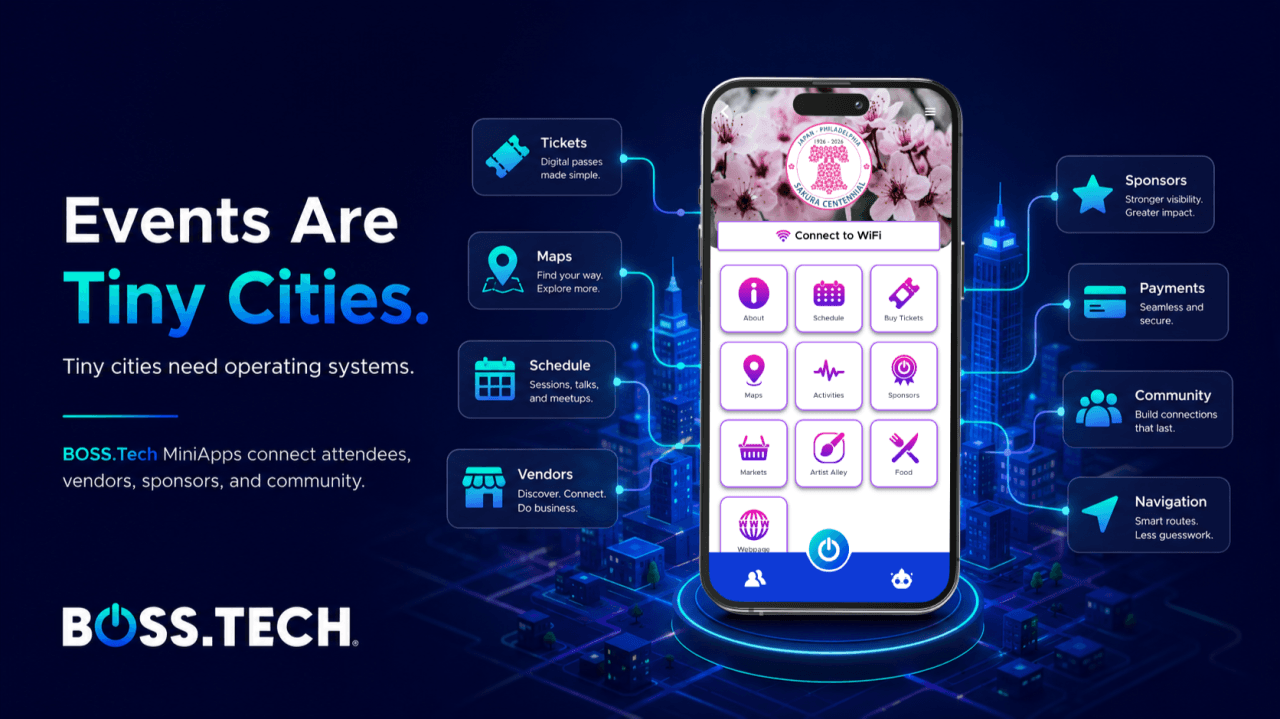
For an event, a BOSS.Tech MiniApp can centralize:
- Tickets
- Schedules
- Maps
- Program information
- Vendor profiles
- Sponsor visibility
- Performer or speaker information
- Venue details
- Attendee navigation
- Partner resources
- Community announcements
But the more powerful story is what happens when participants are onboarded into the platform.
A vendor does not just get a listing.
A nonprofit does not just get a logo.
A performer does not just get a bio.
A local business does not just get mentioned once.
They can receive a BOSS.Tech business account, giving them a path to activate tools for their own operations.
That changes the model.
The event becomes the entry point.
BOSS.Tech becomes the operating system.
From One-Time Participation to Ongoing Business Value
Think about a food vendor at a festival.
In the old model, the vendor applies, gets approved, shows up, sells for a day or a weekend, and leaves.
Their digital relationship with the event may begin and end with a form, a spreadsheet, a map listing, and maybe a social media tag.
In the BOSS.Tech model, that same vendor can be onboarded into a MiniApp and receive a business account.
That account can become useful beyond the event itself.
The vendor can begin using BOSS.Tech to organize business information, connect tools, manage customer interactions, participate in future MiniApps, and explore AI-powered workflows that would otherwise feel out of reach.
Now zoom out.
A maker at an artist market. A nonprofit at a community fair. A sponsor at a civic festival. A performer at a venue. A local business in a tourism app. A franchisee in a brand network. A merchant in a payments partner ecosystem.
Each one can be introduced to BOSS.Tech through a specific MiniApp experience.
That is why events are so powerful.
They gather fragmented businesses and organizations in one place, around one purpose, at one moment in time.
BOSS.Tech turns that moment into an activation channel.
Events Bridge the Digital Divide
The phrase “digital divide” often sounds abstract.
At the event level, it becomes very concrete.
Large companies have software stacks, IT teams, consultants, AI pilots, data strategies, and budgets.
Small vendors, local artists, independent operators, cultural organizations, community groups, and nonprofits often do not.
And yet they are being asked to compete in the same digital economy.
They need better ways to communicate, sell, organize, follow up, understand customers, and participate in modern digital ecosystems.
But most technology asks too much of them.
Too much setup.
Too much cost.
Too much training.
Too much complexity.
Too many disconnected tools.
Events create a better adoption path.
Instead of asking each small organization to discover, evaluate, and implement business software on its own, BOSS.Tech can introduce the platform through something they already understand and already value: participation in an event, festival, venue, market, or community program.
That is practical.
That is mission-aligned.
And that is how technology should spread: through usefulness, not friction.
Why AI Needs an Operating Layer
AI is everywhere in the headlines.
But for many event organizers, vendors, and community groups, AI still feels far away from daily operations.
The reason is simple: AI needs context.
If an organization’s information is scattered across ticketing platforms, spreadsheets, email threads, social media messages, payment systems, forms, and websites, AI cannot reliably help. It has to guess, and guessing is not good enough when people are trying to run real operations.
BOSS.Tech starts with the operating layer.
It helps bring business information and workflows into a more organized, usable environment. That gives AI something better to work with.
For an event ecosystem, that can mean understanding who the vendors are, what information is missing, where attendees need help, which schedules matter, which sponsors need visibility, what follow-up should happen, and how the community can stay connected.
For an individual vendor or organization, it can mean moving toward better communication, better workflows, better data, and better decision-making.
AI becomes useful when it is connected to how the organization actually operates.
That is why BOSS.Tech is not simply an AI tool.
It is a Business Operating System built to make AI practical for the organizations that need it most.
The Subaru Cherry Blossom Festival Proof Point
The 2026 Subaru Cherry Blossom Festival of Greater Philadelphia showed this model in action.
BOSS.Tech helped create a mobile-first MiniApp for the festival, which expected more than 25,000 visitors at Fairmount Park and included more than 30 performances and program items across an expanded footprint.
The MiniApp centralized tickets, maps, schedules, program information, vendors, sponsors, and participating organizations.
The core app was built in approximately 90 minutes.
BOSS.Tech also supported automated onboarding for 100 vendors and organizations.
That is the visible success.
The deeper success is that those 100 vendors and organizations were not merely listed. They were introduced to BOSS.Tech through business accounts that can give them access to broader tools for their own operations.
That is the model for the future.
A festival app becomes a doorway.
A vendor list becomes a business network.
A community event becomes a digital ecosystem.
A weekend experience becomes the first step toward lasting infrastructure.
Read the full case study here: [Subaru Cherry Blossom Festival App Case Study]
Who Should Be Thinking This Way
This model is not limited to festivals.
Any organization that gathers many participants around a shared experience should be thinking about how to turn that moment into a more durable digital ecosystem.
That includes:
- Music festivals
- Cultural festivals
- Food festivals
- Farmers markets
- Artist markets
- Conferences
- Trade shows
- Venues
- Tourism groups
- Chambers of commerce
- Main Street organizations
- Business improvement districts
- Nonprofit coalitions
- City events
- University events
- Franchise networks
- Payments and merchant ecosystems
Each of these environments has the same hidden pattern.
Many participants.
Many tools.
Many workflows.
Many missed opportunities.
One need for a better operating layer.
What Community Leaders Can Build With BOSS.Tech
A BOSS.Tech-powered event or community MiniApp can help leaders create a better experience before, during, and after the event.
Before the event, it can support participant onboarding, vendor profiles, sponsor visibility, schedule organization, ticket links, maps, announcements, and preparation.
During the event, it can help attendees navigate, discover programming, find vendors, access information, and engage with the full ecosystem.
After the event, it can support follow-up, community engagement, vendor continuity, future programming, sponsor reporting, and ongoing business activation.
The after-event piece is where the biggest opportunity lives.
Most event technology is designed around the event date.
BOSS.Tech is designed around the ecosystem.
That means the value can continue after the event ends.
The Future of Events Is Not Just Attendance. It Is Activation.
The old question was: how many people came?
That still matters.
But the better question is: what did the event activate?
Did it activate local businesses?
Did it activate vendors?
Did it activate sponsors?
Did it activate artists?
Did it activate community organizations?
Did it activate new customer relationships?
Did it activate data that can help the organizer improve next year?
Did it activate a network that becomes more valuable over time?
BOSS.Tech helps community leaders answer yes.
Because an event should not disappear when the tents come down.
It should become part of a living digital ecosystem.
Events Are Tiny Cities. Tiny Cities Need Operating Systems.
A city needs maps, communication, commerce, services, infrastructure, identity, coordination, and trust.
So does an event.
The difference is that events are compressed in time.
That compression makes the need for better systems more obvious.
When the schedule is wrong, people notice.
When the map is confusing, people notice.
When vendors are hard to find, they lose sales.
When sponsors are buried, they lose value.
When organizers have to coordinate everything manually, the system depends on heroics.
BOSS.Tech exists to reduce the need for heroics.
It gives organizers and community leaders a way to turn fragmented activity into a connected operating layer.
It gives vendors and organizations a way to move from one-time participation to lasting business value.
It gives attendees a simpler way to navigate and engage.
It gives sponsors and partners a richer ecosystem to support.
And it gives communities a path to carry the energy of an event beyond the event itself.
Events are tiny cities.
Tiny cities need operating systems.
That is what BOSS.Tech is building.
Ready to turn your event, venue, festival, or community ecosystem into a connected digital movement?
Book a BOSS.Tech demo or request our community MiniApp partnership guide.