AI Was Never Meant to Replace Your Team
July 21, 2026
Every time a new AI tool launches, the conversation seems to go in the same direction.
Will AI replace jobs?
Will companies hire fewer people?
Should employees be worried?
They're fair questions, but I think they're focused on the wrong thing.
Most businesses don't have a people problem. They have a friction problem.
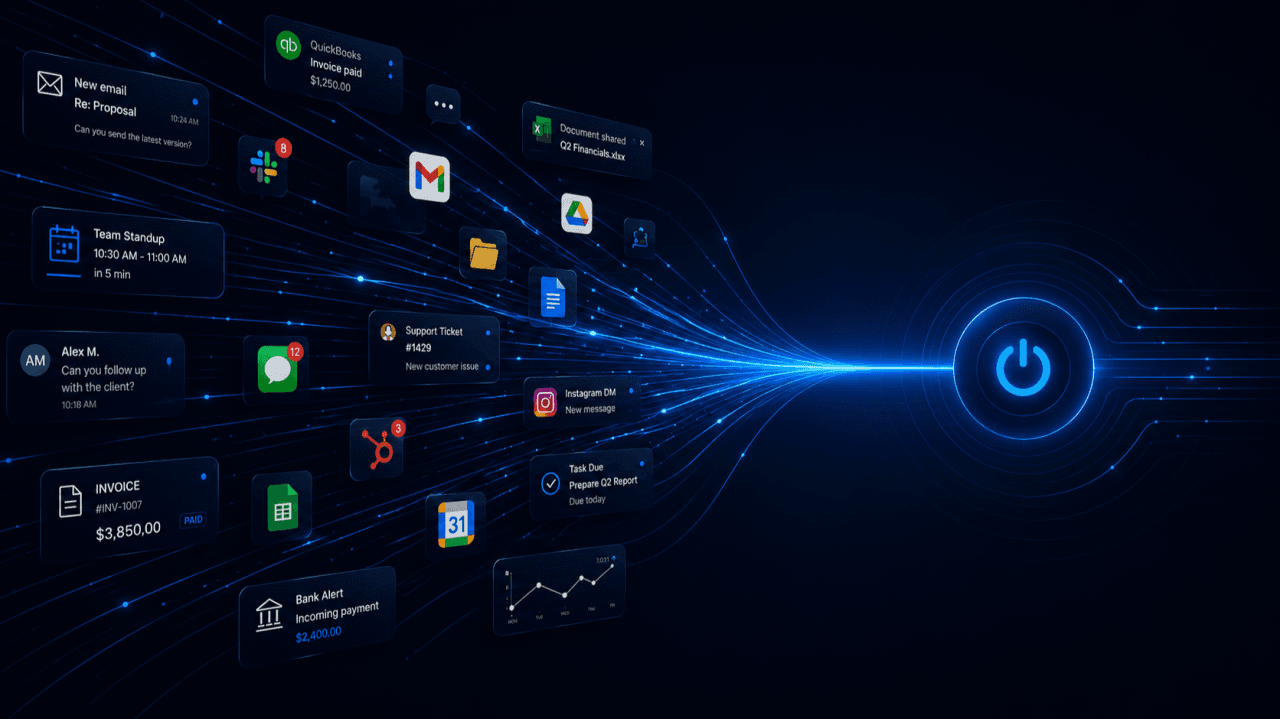
Not the kind of friction that shows up in quarterly reports or board meetings. The kind that's woven into hundreds of tiny moments throughout the day. Searching for a file someone swears is "in the shared drive." Looking for the latest version of a proposal. Copying the same customer information into three different systems. Switching between your email, calendar, CRM, accounting software, and messaging apps just to answer one simple question.
None of those tasks are particularly difficult. They're just constant.
Individually, they only take a minute or two. Together, they quietly consume hours of every workday.
We've become so used to this operational drag that we've accepted it as part of doing business. We even celebrate people who can "juggle everything," when in reality they're spending an incredible amount of mental energy keeping disconnected systems moving.
That's not productivity. It's survival.
The irony is that many of these moments don't require human judgment at all. They don't need creativity, empathy, negotiation, or strategic thinking. They simply exist because the tools businesses rely on were never designed to work together.
For years, software has solved individual problems. One app manages invoices. Another handles calendars. Another stores customer information. Another sends messages. Another tracks projects.
Each one may do its job well, but every time a person has to move between them, a little bit of momentum disappears.
That momentum is expensive.
Not because switching tabs is hard (but it is expensive), but because every interruption forces your brain to reload context. What was I doing? Where was that file? Did I already reply? Which customer was this attached to?
Multiply that by dozens, or even hundreds, of times a day across an entire company, and you start to see where so much productivity actually goes.
This is where I think AI's biggest opportunity lies.
Not in replacing the person. In removing the unnecessary work surrounding the person.
Imagine opening your workspace and already having the context you need. The customer profile, recent conversations, outstanding invoices, upcoming meetings, and open tasks are connected before you even ask. Instead of hunting for information, you're making decisions with it.
That's a very different vision of AI than the one dominating headlines.
The goal isn't fewer employees. It's fewer interruptions.
The goal isn't replacing expertise. It's making expertise easier to apply.
The goal isn't automating people out of the business. It's removing the countless tiny moments that keep people from doing the work only humans can do.
This is exactly how we think about AI at BOSS.Tech.
We don't believe AI's greatest value comes from replacing people. We believe it comes from removing the friction that prevents people from doing their best work.
Business owners didn't start companies because they wanted to spend their days switching between apps, searching for information, or trying to remember where something lives. They started companies to build something meaningful, serve customers, and grow.
That's why we're building a Business Operating System that brings together the information businesses already have, connects it across the tools they already use, and adds the context that's been missing. AI shouldn't create another place to work. It should quietly help the work happen.
The companies that benefit most from AI won't necessarily be the ones with the most AI features. They'll be the ones that remove the most friction from everyday work.
At BOSS.Tech, that's the standard we build toward every day.
Because the future of work isn't about replacing humans.
It's about finally letting humans focus on the work that matters.