The Invisible Work Running Your Business
The Invisible Work Running Your Business
No one talks about this part of running a business.
Not the strategy. Not the growth. Not the wins.
The part that quietly drains you every day.
It’s the message you need to answer later. The invoice you have to remember to send. The client detail sitting in your notes app. The follow-up you’re holding in your head because there isn’t a proper place for it yet.
So you carry it with you.
Most founders and operators don’t notice how heavy this becomes, because it happens gradually. A few reminders here. A few mental tabs there. Until your business isn’t just something you run during work hours. It’s something you carry in your mind all the time.
This is the invisible work behind every modern business.
And it’s exhausting.
The Work That Doesn’t Show Up on a Dashboard
We tend to think of work as what happens inside tools. Emails sent. Meetings booked. Payments received. Tasks completed.
But the real effort often lives between those actions.
It lives in remembering to follow up with a lead you spoke to last week. In trying to recall where a client conversation happened. In switching between apps to piece together a single moment of context. In keeping track of who paid, who hasn’t, and who needs a reminder.
None of this appears in productivity reports. Yet it consumes time, attention, and energy every single day.
Most businesses aren’t overwhelmed because they lack tools. They’re overwhelmed because their tools don’t speak to each other. Information lives in separate places, and the person running the business becomes the one responsible for connecting everything.
You become the system.
The Lie We’ve Been Sold About Productivity
When this starts to feel heavy, the default assumption is personal failure.
We think we need better habits. Better discipline. A more organized workflow. Another platform to help us stay on top of things.
So we add more tools.
A new CRM. Another messaging platform. A separate invoicing system. An extra calendar. More integrations to manage.
Instead of reducing the mental load, this usually increases it. Because now there are even more places where information can live, and even more responsibility on the business owner to keep everything aligned.
The problem was never effort.
The problem is that most business systems don’t carry context. People do.
When Your Business Lives in Your Head
Think about how many details you hold mentally throughout a normal day.
You remember that a client prefers text over email. You remember that another one hasn’t paid yet. You remember to send a proposal after a call. You remember to follow up on a conversation from last week.
This information exists across messages, payment tools, calendars, and notes. But it rarely exists together. So your brain becomes the place where everything connects.
Even when you’re not working, your business is still running in the background of your mind. You replay conversations. You worry about what you might have missed. You keep small mental reminders active so nothing slips through the cracks.
This constant cognitive load is one of the most underestimated challenges of running a business today.
It’s not the big decisions that burn people out. It’s the accumulation of small, unfinished loops.
What If Your Business Could Carry Its Own Context?
Imagine if your systems didn’t just store information, but understood how it all connects.
A contact isn’t just a name and number, but a full history of conversations, payments, and interactions. A message isn’t isolated in an inbox, but connected to the person and the work behind it. A calendar event isn’t just a time slot, but part of an ongoing relationship. A payment reminder doesn’t rely on memory, because the system already knows what’s pending.
When context moves with the information, something changes. The business stops depending on your brain to hold everything together.
You stop acting as the glue between disconnected tools.
This is where work begins to feel lighter. Not because you care less about your business, but because your systems finally support the way real businesses operate.
This Is Where BOSS.Tech Comes In
BOSS.Tech was built around a simple belief. Running a business shouldn’t require carrying it in your head at all times.
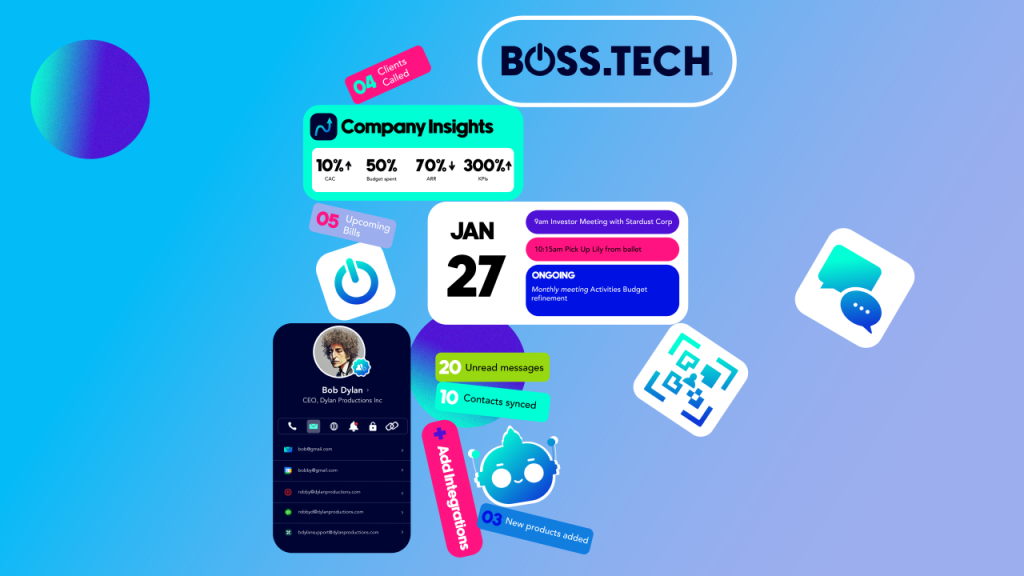
Instead of adding another tool to the stack, BOSS.Tech brings the core functions of a business into one connected environment. Messages, contacts, calendar, payments, accounting, and communication tools don’t live in isolation. They inform each other.
When a client reaches out, their context is already there. When a payment is due, reminders don’t depend on memory. When you schedule something, it connects to the people and conversations behind it.
AI works quietly in the background to keep information organized, synced, and actionable, so you don’t have to manually connect the dots between systems.
The result isn’t just efficiency. It’s clarity.
Your business becomes something that exists in a structured, connected space instead of scattered across apps and mental notes. You spend less time tracking and remembering, and more time actually running and growing the business.
A Lighter Way to Run a Serious Business
There’s a common belief that if you’re doing serious work, it has to feel heavy. That constant pressure and mental load are simply part of being responsible for something important.
But much of that weight doesn’t come from the work itself. It comes from the way our tools and systems are structured. Or more accurately, how disconnected they are.
When your business systems carry context for you, the experience of running a business changes. Work feels contained instead of endless. Clear instead of scattered. Manageable instead of constantly on your mind.
You still care deeply about what you’re building. You’re still involved. Still thoughtful. Still responsible.
You’re just not carrying everything alone anymore.
That’s the shift BOSS.Tech is built to create.
Business. Easier.