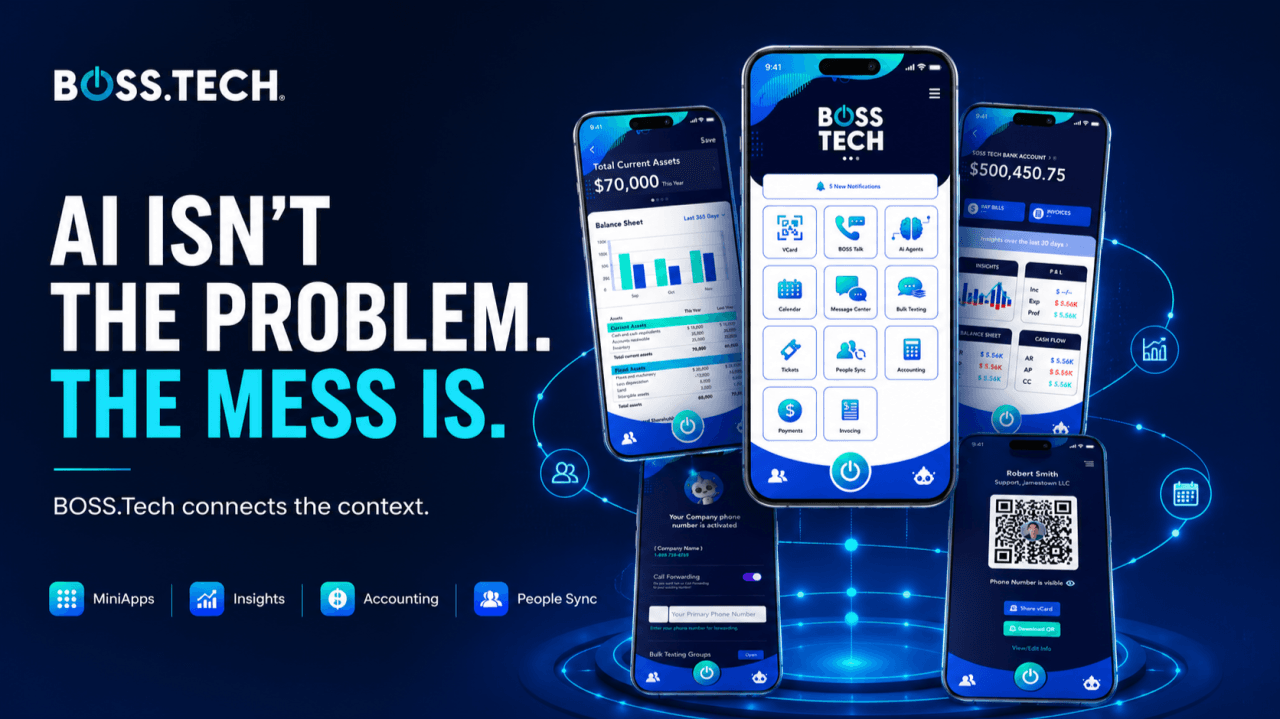
AI Doesn't Fail Because It's Not Smart. It Fails Because Your Data Is a Mess.
June 3, 2026
AI Doesn’t Fail Because It Isn’t Smart. It Fails Because the Data Is a Mess.
TL;DR
- Most AI initiatives disappoint because AI is asked to reason over fragmented, incomplete, disconnected business information.
- Businesses do not need "smarter chatbots" as much as they need clean, connected, actionable business context.
- BOSS.Tech is building the operating layer that makes AI useful: BOSSi connects and normalizes data, Insights makes it understandable, MiniApps make it usable, and Flows turns it into action.
AI is not the problem.
The mess is the problem.
Every day, businesses are told they need to “add AI.”
Add AI to sales. Add AI to customer support. Add AI to marketing. Add AI to operations. Add AI to finance. Add AI to everything.
But when AI does not produce meaningful business results, people assume the AI was not smart enough.
That is usually the wrong diagnosis.
The bigger issue is that the AI cannot see the business clearly.
It is being asked to make sense of information scattered across email, calendars, CRMs, spreadsheets, accounting tools, payment systems, text messages, support tickets, social media DMs, project management platforms, inventory tools, and the memory of whoever has been holding the company together with caffeine and force of will.
That is not intelligence.
That is guesswork.
And no matter how powerful the model becomes, it cannot reliably operate a business it cannot understand.
That is the BOSS.Tech thesis:
AI does not fail because it is not smart. It fails because the data is a mess.
The "Just Add AI" Era Is Already Breaking
The first wave of AI adoption was thrilling.
For the first time, non-technical people could ask software to write, summarize, analyze, brainstorm, generate, translate, code, organize, and reason in natural language.
That was a big deal.
But then businesses tried to move from impressive demos to actual operational value.
That is where the wheels started to wobble.
A chatbot can draft an email.
But can it know which customer needs the email?
A model can summarize a document.
But can it tell whether the document is the current version?
An AI assistant can generate a sales follow-up.
But does it know what happened in the last support ticket, invoice, meeting, text message, and contract conversation?
An AI tool can recommend a next step.
But does it know whether the business has the staff, budget, permission, timing, customer context, and operational capacity to take that step?
That is the gap between AI as a novelty and AI as infrastructure.
The problem is not that AI cannot help.
It absolutely can.
The problem is that most businesses are asking AI to operate without a clean operating layer.
They are putting intelligence on top of fragmentation.
And fragmentation wins.
The Real AI Bottleneck Is Business Context
AI needs context.
Not just words.
Not just prompts.
Not just a PDF uploaded into a chat window.
It needs the actual context of how a business works.
That includes:
- Who the customers are
- What they bought
- What they asked
- What they were promised
- What invoices are open
- What meetings happened
- What follow-ups are overdue
- What support issues are unresolved
- What inventory is available
- What data is trusted
- Which systems are current
- What workflows matter
- Who has permission to act
- What should happen next
Most businesses have that information somewhere.
The problem is that “somewhere” is everywhere.
One part is in QuickBooks. One part is in Google Workspace. One part is in HubSpot. One part is in Zendesk. One part is in Stripe. One part is in Twilio. One part is in Meta messages. One part is in a spreadsheet. One part is in someone’s inbox. One part is in someone’s head.
That is not a data strategy.
That is operational archaeology.
AI can only be as useful as the context it can access, trust, and act on.
If the data is fragmented, AI becomes shallow.
If the data is stale, AI becomes wrong.
If the data is incomplete, AI becomes overconfident.
If the data is disconnected, AI becomes a fancy interface on top of the same old mess.
That is why the future of AI in business does not begin with a chatbot.
It begins with an operating system.
Small Businesses Feel This Pain First
Large enterprises have problems with messy data too.
But small and mid-sized businesses feel the pain differently.
They do not usually have dedicated IT teams. They do not have data engineers cleaning pipelines. They do not have enterprise integration budgets. They do not have consultants mapping workflows for six months. They do not have teams of analysts turning chaos into dashboards.
They have owners, operators, managers, admins, salespeople, customer success teams, bookkeepers, vendors, partners, and employees doing their best across whatever software they could afford, adopt, or inherit.
That creates a cruel irony.
The businesses that could benefit most from AI often have the least ability to prepare their data for AI.
They need help answering urgent questions:
- Which leads are falling through the cracks?
- Which customers are unhappy?
- Which invoices need attention?
- Which messages require a response?
- Which workflows are wasting time?
- Which opportunities are invisible because the data lives in different systems?
- Which tasks should be automated?
- Which business decisions are being made from incomplete information?
AI should help with all of this.
But it cannot do it reliably if the business is fragmented at the foundation.
That is why BOSS.Tech is building for what we sometimes call the "IT-Teamless" business.
Not because these businesses are unsophisticated.
Because they are underserved.
They need the power of modern AI without being forced to become software integration experts first.
The BOSS.Tech Answer: Connect, Normalize, Understand, Act
BOSS.Tech is an AI-native Business Operating System.
That phrase means something specific.
It means BOSS.Tech is not trying to become one more disconnected point solution.
It is designed to sit across the tools businesses already use, connect fragmented systems, normalize business information, and make that information useful through MiniApps, Insights, and Flows.
The platform is built around a simple sequence:
Connect the data. Normalize the data. Make it understandable. Make it actionable.
That sequence matters.
Skipping straight to AI without fixing the data layer is like hiring the smartest person in the world, blindfolding them, spinning them around, and asking them to run your business.
BOSS.Tech removes the blindfold.
BOSSi: The Data Layer AI Actually Needs
BOSSi is the integration and synchronization framework behind BOSS.Tech.
Its job is to help connect, synchronize, and normalize data across the software businesses already use.
That matters because most business data is not neatly organized for AI.
It is shaped by each vendor’s system.
Customer records may look different across tools. Names may not match. Messages may be disconnected from transactions. Calendar events may not connect to customer history. Invoices may not connect to support issues. Social messages may not connect to sales opportunities. A business may not even know which system is the source of truth.
BOSSi is built to address that fragmentation.
For AI, this is foundational.
A model cannot give trustworthy business guidance if it does not know whether “Bob Smith,” “Robert Smith,” “B. Smith,” and “bob@company.com” are the same person.
It cannot identify a revenue opportunity if the payment data, message history, and customer relationship data never meet.
It cannot automate a workflow if the trigger lives in one system, the context lives in another, and the action needs to happen in a third.
BOSSi gives BOSS.Tech the ability to make business data more coherent.
That is what AI needs before it can become operationally useful.
Insights: AI That Understands the Business Context
Once business information is connected and normalized, AI can become much more useful.
That is where Insights comes in.
Insights is the intelligence layer of BOSS.Tech. It is designed to help businesses understand what is happening across their operations and what may need attention.
This is the difference between asking AI a generic question and giving AI real business context.
A generic AI tool might help write a marketing email.
BOSS.Tech can move toward a more useful question:
Which customers should receive a follow-up, based on recent activity, payment status, open issues, and engagement?
A generic AI tool might summarize a support ticket.
BOSS.Tech can move toward:
Which support issues may put revenue at risk because they involve important customers, unresolved complaints, or recent billing friction?
A generic AI tool might draft a task list.
BOSS.Tech can move toward:
Which actions should happen today based on actual business signals across tools?
That is the promise of AI with context.
Not magic.
Not hype.
Just better intelligence because the system can finally see more of the business.
MiniApps: Turning Intelligence Into Usable Experiences
Clean data alone is not enough.
Insights alone are not enough.
People need usable experiences that fit the way they work.
That is where MiniApps matter.
MiniApps are configurable applications built for specific workflows, industries, communities, or business needs.
Instead of asking every business to stare at one giant dashboard, MiniApps can shape the experience around the actual job to be done.
A festival MiniApp can centralize tickets, maps, schedules, vendors, and sponsors.
A franchise MiniApp can help franchisees and franchisors coordinate operations.
A game cafe MiniApp can manage inventory, members, preferences, and recommendations.
An AI CRM MiniApp can help small businesses follow up with customers more intelligently.
A policy MiniApp can turn scattered policies into operational guidance.
The point is not to create endless software clutter.
The point is to create focused business experiences on top of a connected operating layer.
That is how AI becomes useful to real people.
Not as a blank prompt.
As part of the workflow.
Flows: Intelligence Has to Move Work Forward
A business does not need AI that only explains the problem.
It needs AI that helps move work forward.
That is the role of Flows.
Flows supports workflow automation and recurring business processes.
Once data is connected, normalized, and understood, BOSS.Tech can help trigger actions, automate tasks, surface reminders, and support recurring operations.
This is where AI begins to matter operationally.
Not “write me a paragraph.” Not “summarize this document.” Not “make me a list.”
Instead:
- Notify the right person when a customer needs attention.
- Create a follow-up when a payment and support issue overlap.
- Escalate an unresolved message.
- Trigger a workflow when a vendor is missing information.
- Prepare a report from connected business activity.
- Identify patterns across systems.
- Help a business act before the opportunity is lost.
The best AI does not just talk.
It helps work happen.
Why This Matters for Builders
This messy data problem is not just a customer problem.
It is a builder opportunity.
The next generation of builders will not win by creating more generic apps.
They will win by understanding business operations.
They will know how to ask:
- Where does the data live?
- What workflow is broken?
- What context does AI need?
- Which action should happen next?
- Which user needs this insight?
- Which systems need to connect?
- What business outcome are we improving?
That is why BOSS.Tech matters as a builder platform.
It gives builders a place to create software that is tied to real business context.
Builders can create MiniApps, integrations, automations, and AI-powered workflows that address actual operational pain.
That is very different from building another standalone tool and hoping someone adopts it.
BOSS.Tech gives builders a platform where the messy business problem is the starting point, not an afterthought.
Why This Matters for Universities and Developer Programs
Universities and coding programs are trying to teach AI in a world that is changing faster than curriculum can keep up.
But the most important AI skill may not be prompt writing.
It may be operational understanding.
Students need to learn how AI works in messy real environments:
- Incomplete data
- Conflicting systems
- Unclear workflows
- Business constraints
- Privacy and permission concerns
- Customers with real needs
- Operators with limited time
- Organizations without IT teams
That is applied AI.
Not AI in a vacuum.
Not toy examples.
Not demos disconnected from business reality.
A Build w/BOSS.Tech program gives universities and developer organizations a way to teach AI through real business problems.
Students can learn to build with context.
Developers can learn to solve workflow pain.
Entrepreneurship programs can connect technical talent to actual market needs.
Community organizations can give builders problems that matter.
That is how AI education becomes useful.
The Bigger Point: AI Needs an Operating System
For the last decade, businesses accumulated software.
Now they are trying to add AI on top.
But software sprawl plus AI does not automatically equal intelligence.
In many cases, it creates a louder version of the same confusion.
More tools. More alerts. More dashboards. More disconnected recommendations. More things to check. More places for work to fall through the cracks.
The answer is not simply another AI app.
The answer is an operating layer.
BOSS.Tech exists because businesses need a way to make their existing software, data, workflows, and AI work together.
That is the real infrastructure problem.
And solving it matters because AI will only become transformational when it is grounded in how businesses actually operate.
The Invitation
AI is getting smarter.
That is good.
But smarter AI alone will not fix messy business operations.
The businesses that win with AI will be the ones that can give AI the context it needs.
The builders who win with AI will be the ones who understand how to turn fragmented business data into useful workflows.
The universities that lead in AI education will be the ones that teach students to solve real operational problems.
The platforms that matter most will be the ones that do not merely generate outputs.
They will connect data, structure context, enable action, and create business value.
That is what BOSS.Tech is building.
BOSSi connects and normalizes the data.
Insights helps businesses understand what matters.
MiniApps turn intelligence into usable experiences.
Flows moves work forward.
Because AI does not fail because it is not smart.
It fails because the data is a mess.
And BOSS.Tech is building the Business Operating System to clean up the mess, connect the context, and help businesses finally put AI to work.
Interested in building AI-powered business workflows on BOSS.Tech or bringing Build w/BOSS.Tech to your university, developer community, coding program, or builder organization?
Partner with BOSS.Tech to create applied AI, MiniApp, integration, and business automation experiences for your community.