37 Teams. 100+ Builders. One Question: What Can You Build on a Business Operating System?
June 2, 2026
37 Teams. 100+ Builders. One Question: What Can You Build on a Business Operating System?
TL;DR
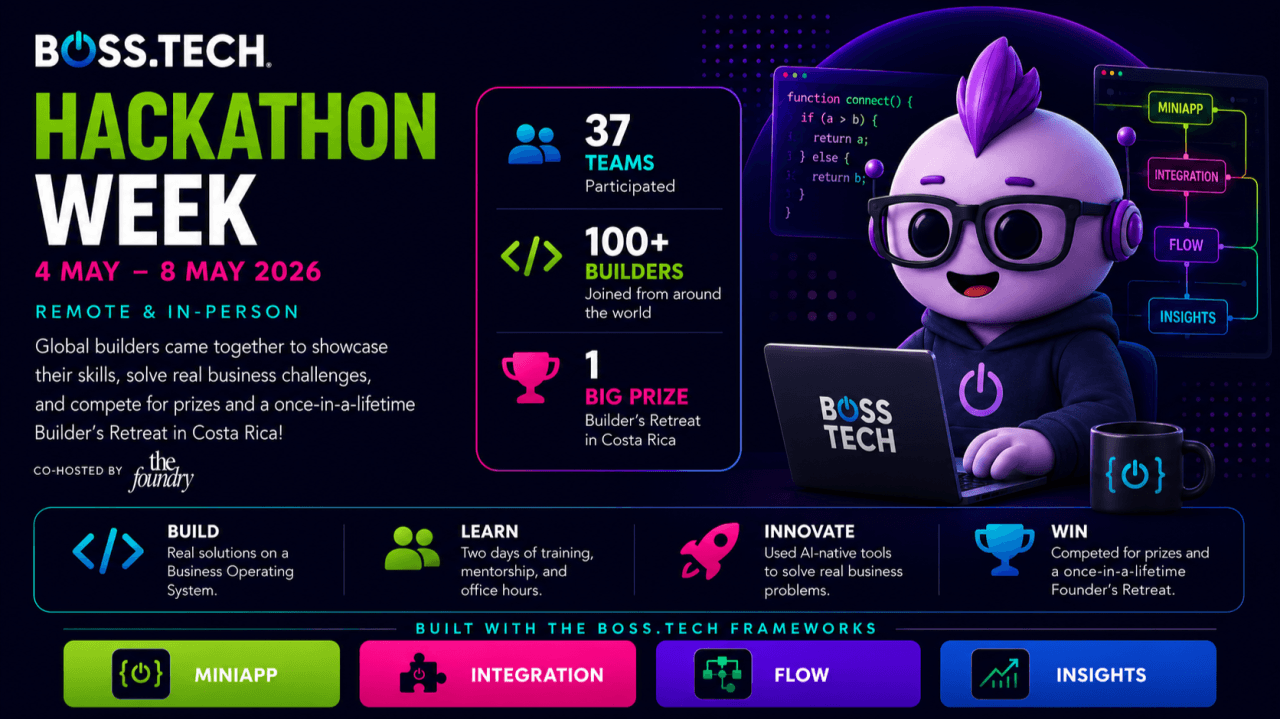
- BOSS.Tech sold out its Build w/BOSS.Tech hackathon with 37 teams and more than 100 registrants, bringing together builders, developers, students, founders, and operators to solve real business problems.
- Participants used BOSSi docs, the MiniApp framework, APIs, BOSS.Tech mentors, office hours, and two days of training to explore what can be built on an AI-native Business Operating System.
- The hackathon proved a bigger thesis: universities, developer communities, and builder organizations can give their communities more than a coding challenge. They can give them a platform for building real business software.
Most hackathons ask a familiar question:
What can you build in a weekend?
BOSS.Tech asked a different one:
What can you build on a Business Operating System?
That question brought together 37 teams and more than 100 registrants for the Build w/BOSS.Tech hackathon, a sold-out builder activation designed to test a simple but powerful idea:
Business software should not force companies to contort themselves around disconnected tools. Builders should be able to create software around how businesses actually operate.
That's the heart of BOSS.Tech.
And it's why this hackathon mattered.
This wasn't just a coding competition. It was a live experiment in applied AI, business automation, MiniApps, integrations, workflow design, and developer-led problem solving.
It was also a glimpse into a future where universities, coding communities, entrepreneurship programs, and builder organizations can give their communities access to real platforms, real business problems, and real opportunities to create.
Why This Hackathon Was Different
Hackathons are everywhere.
Some are inspiring. Some are fun. Some are chaotic. Some produce clever demos that disappear the next day.
The best hackathons do more.
They help builders learn new tools, meet collaborators, test ideas, and work on problems that matter beyond the event itself.
That was the goal of Build w/BOSS.Tech.
The hackathon was built around real business pain:
- Small businesses using too many disconnected tools
- Operators struggling to understand what is happening across their business
- Teams manually moving information between systems
- AI tools that are powerful but disconnected from actual business context
- Entrepreneurs who need software that adapts to their business model instead of the other way around
That last point matters.
Most business software asks users to fit the system.
BOSS.Tech asks builders to create systems that fit the business.
That changes what a hackathon can be.
Instead of building novelty demos, teams were challenged to build useful, business-ready concepts on top of an operating layer designed for integrations, MiniApps, insights, and automation.
The Platform Behind the Challenge
BOSS.Tech is an AI-native Business Operating System.
That phrase is intentionally bigger than "app."
An app usually solves one problem.
A Business Operating System creates a foundation for many business problems to be solved in one connected environment.
For builders, that matters because the most interesting business problems rarely live inside one tool.
A customer issue might involve email, text, support tickets, payments, inventory, calendar availability, and CRM history.
A small business may need to coordinate scheduling, messaging, billing, vendor data, social media, and follow-up.
A franchise operator may need to see what is happening across locations.
A festival vendor may need to participate in an event app, communicate with customers, manage orders, and prepare for the next market.
A founder may need AI that understands the business context, not just a prompt in a blank chat window.
That's why BOSS.Tech gave builders access to the platform's core building blocks.
Participants used:
- BOSSi docs
- The MiniApp framework
- APIs
- BOSS.Tech mentors
- Ryan, Felicite, and team office hours
- Two days of training sessions before the event
The goal was not simply to teach a tool.
The goal was to give builders a new way to think about business software.
The Four Ways Builders Could Build
The hackathon centered around four core BOSS.Tech frameworks:
BOSSi
BOSSi is the integration and synchronization layer. It helps connect and normalize information across the software businesses already use.
For builders, BOSSi is about making fragmented data usable.
MiniApps
MiniApps are configurable business applications built from reusable components and tailored workflows.
For builders, MiniApps are about creating focused business experiences without starting from scratch every time.
Insights
Insights brings AI-powered intelligence into business operations.
For builders, Insights is about helping users understand what is happening and what to do next.
Flows
Flows supports workflow automation and recurring business processes.
For builders, Flows is about turning business logic into action.
Together, these frameworks invite a very different kind of build.
- Make a business workflow smarter.
- Make scattered information usable.
- Make AI practical.
- Make software fit the operator.
How the Hackathon Was Judged
A serious builder event needs more than excitement.
It needs a clear definition of what good looks like.
The Build w/BOSS.Tech rubric used 100 points across five categories:
- Platform Use & Implementation 40 points
- Business Value 25 points
- Innovation & Creativity 20 points
- Demo & Storytelling 10 points
- Polish & Usability 5 points
This kept the focus where it belonged.
Teams were not rewarded for flash alone.
They were rewarded for building something useful, creative, demonstrable, business-ready, and meaningfully connected to the BOSS.Tech platform.
Judges looked for:
- Strong use of MiniApps, BOSSi, Flows, and Insights
- Depth of implementation
- Configurable architecture
- Working demos
- Permission-aware design
- Business impact
- Originality
- Clear storytelling
The challenge was not merely to impress.
The challenge was to build something that could become real.
The Winners
The winning projects showed the range of what builders can imagine when they start from real business problems.
First Place: AI CRM
Built by Afeef Allahbaksh, Muhammad Rohan Khan, and Toshan Gosain of Drexel University, AI CRM is an automated AI CRM for small and mid-sized businesses.
The project tackled one of the most persistent problems in business operations: customer relationships are valuable, but managing them manually is slow, fragmented, and easy to neglect.
AI CRM explored how AI can help SMBs automate and improve customer relationship management in a way that feels more accessible to real operators.
Congratulations to the Drexel University team. Go Dragons.
Second Place: Divided by *
Built by Andrew Snyder, **Divided by *** is an app for game cafés.
The concept gives members access to the café's inventory of games, tracks who has what, and connects to a database that can recommend games each group may like based on player preferences.
This is exactly the kind of use case that makes BOSS.Tech interesting: a specific business with a specific operating model, where generic software is unlikely to fit perfectly.
A game café does not just need inventory.
It needs membership, discovery, recommendations, borrowing, preference-matching, and a better customer experience.
That is a business workflow waiting to become software.
Third Place: Polyxa
Built by S4 Collective, Polyxa is an Autonomous Policy Proxy.
The team described it as a Fractional Chief of Policy for the agile entrepreneur.
In many business environments, policies and operating procedures are scattered across documents, departments, and systems. That makes them difficult to find, difficult to interpret, and even harder to act on.
Polyxa acts as a centralized intelligence layer that normalizes fragmented policy information into a consistent, machine-readable format.
Instead of forcing users to navigate complex databases or documents, Polyxa allows them to interact with the system to get real-time, policy-compliant answers and actions.
The business value is clear: by automating policy checks and verification, organizations can reduce administrative overhead and scale faster with more confidence.
That is not a toy problem.
That is a real operational pain point.
What Builders Saw in BOSS.Tech
One builder captured the promise of BOSS.Tech beautifully:
"Just being able to pull the things that you need to serve your customers into one interface without having to go through a point of sale app to enter inventory or try to get existing software to fit your business model, to take everything you need and nothing you don't, easily, that's the best thing about BOSS.Tech."
The best phrase in that quote may be this:
Everything you need and nothing you don't
That is the builder opportunity.
Not more bloated software.
Not more disconnected tools.
Not yet another dashboard.
BOSS.Tech gives builders a way to create focused software around the actual needs of a business, community, workflow, or customer experience.
That is useful for developers.
It is useful for founders.
It is useful for universities.
It is useful for organizations that train, support, and activate coders.
Because the future of software will not only belong to people who can write code.
It will belong to builders who understand real-world operations.
Why This Matters for Universities
Universities are looking for better ways to teach applied AI.
Students do not just need lectures about AI.
They need to build with it.
They need to understand how AI connects to real data, real workflows, real customers, real business models, and real constraints.
They need to learn that the hard part is not always generating an answer.
The hard part is knowing what the business needs, where the data lives, what workflow matters, who the user is, and how to turn intelligence into action.
That is exactly where BOSS.Tech can help.
A Build w/BOSS.Tech event gives universities a practical platform for:
- Applied AI education
- Entrepreneurship programs
- Computer science projects
- Product design
- Business automation
- Civic innovation
- Student founder development
- Interdisciplinary collaboration
A computer science student can build with a business student.
A design student can shape the user experience.
An entrepreneurship student can define the customer problem.
A university partner can give students something more valuable than a hypothetical case study.
They can give them a real platform and real business problems.
Why This Matters for Developer Communities and Builder Organizations
Universities are only part of the story.
Developer communities, coding groups, accelerators, workforce programs, founder networks, civic tech organizations, and builder communities are also looking for better ways to help people build meaningful things.
The world does not need more demo days where everyone builds a chatbot and forgets it a week later.
Builders want to work on real problems.
Communities want to create opportunity.
Organizations want tools that help their members develop practical skills.
BOSS.Tech can become a platform for that.
It gives builder communities a way to create programs around:
- AI-powered business applications
- SMB technology
- Workflow automation
- Vertical software
- MiniApp creation
- Integration design
- Business operations
- Entrepreneurial problem solving
- Community and civic use cases
This is where the democratization story becomes powerful.
Not every community has access to enterprise-grade software platforms.
Not every student has a startup network.
Not every new developer has a realistic business problem to solve.
Not every small business has access to custom software.
BOSS.Tech can help connect those worlds.
Builder communities can learn by solving real problems for real organizations.
Small businesses and community organizations can benefit from tools they could not have built alone.
That is not just education.
That is ecosystem building.
Why This Matters for BOSS.Tech
For BOSS.Tech, the hackathon proved something important.
The company does not have to build every solution itself.
That would be impossible anyway.
The world of small and mid-sized business operations is too broad, too fragmented, and too specific for one team to solve every workflow, every industry, every community, and every niche.
The better strategy is to enable builders.
Let a game café workflow be built by someone who understands game cafés.
Let an AI CRM emerge from builders who understand the pain of neglected customer relationships.
Let an autonomous policy proxy emerge from a team thinking deeply about compliance, policy, and fast-moving entrepreneurship.
Let universities and communities become partners in teaching people how to build for real business operations.
That is the ecosystem strategy.
BOSS.Tech provides the operating layer.
Builders create the use cases.
Partners activate the communities.
Customers get better software.
The Code to Costa Rica Follow-Through
The hackathon did not end with Demo Day.
The next milestone is Code to Costa Rica, a builder retreat designed to see what committed builders can create with deeper access to the platform.
That matters because the real test of a builder ecosystem is not whether people can build something once.
It is whether they want to keep building.
The retreat gives BOSS.Tech and its builders the opportunity to go deeper: more time, more platform access, more feedback, more collaboration, and more insight into what developer partners can create when they are given the right tools and support.
The goal is not just to celebrate winners.
The goal is to learn what a committed builder community can become.
A Tool for Developer Partners
For BOSS.Tech, developer partners can play a role similar to the way franchisors and ISOs can serve as channels into SMB markets.
A university can introduce students to applied AI and business automation.
A coding organization can give its members a platform for building real business apps.
A developer community can host a challenge around meaningful workflows.
An accelerator can help founders build operational tools faster.
A civic tech organization can connect builders with local business and community needs.
The partner brings the community.
BOSS.Tech brings the platform.
Builders bring the imagination.
Together, they can create real solutions.
That is the model.
What Can You Build on a Business Operating System?
The Build w/BOSS.Tech hackathon answered the title question with 37 different attempts.
An AI CRM
A game café operating and recommendation app
An autonomous policy proxy
And dozens of other ideas shaped by builders who were willing to explore a new kind of platform
But the bigger answer is still unfolding.
What can students build when they are given real business context?
What can developers build when they are not limited to disconnected point solutions?
What can universities teach when applied AI becomes hands-on?
What can community organizations create when their members are invited to solve real operational problems?
What can small businesses gain when builders start building for them?
That is the question BOSS.Tech wants to keep asking.
And it is the invitation we are extending to universities, developer communities, coding programs, entrepreneurship centers, accelerators, and organizations that support builders.
Bring Build w/BOSS.Tech to your community.
Give your builders real business problems.
Give them a real platform.
Then let's see what they create.
Interested in bringing Build w/BOSS.Tech to your university, developer community, coding program, or builder organization?
Partner with BOSS.Tech to host an applied AI and business automation experience for your community.