Digital Transformation Widened the Digital Divide for SMBs. AI is Widening it Faster.
It’s National Small Business Week. Let’s be honest about what many entrepreneurs are facing right now.
The digital divide is no longer about who has internet access. For businesses, the divide has evolved. It’s now about who has the time, tools, structure, talent, and usable data to actually benefit from modern technology. And who’s being left to drown in the noise. National Small Business Week 2026 runs from May 3–9 (a Universe coincidence with Philly Tech Week – I’m IN), recognizing the contributions of America’s entrepreneurs and small business owners. There are more than 36.2 million small businesses in the United States, creators of 61% of net new jobs since 1995. (SBA)
That matters. Because the stakes are enormous.
Small business is not a niche. It’s our economy’s proving ground. But they’re being asked to navigate one of the fastest technology shifts in modern history -with the fewest resources, the least spare time, and almost never an internal IT team. OECD notes smaller businesses continue to lag in digital transformation because of low awareness, insufficient internal resources, skill deficiencies, and financial limitations. Its 2026 SME AI survey found that while adoption of off-the-shelf AI tools is rising, strategic, targeted, and secure integration into business operations remains uneven, and time constraints, maintenance costs, and skills gaps still block effective implementation. (OECD)
That’s the new digital divide. It is not simply access to technology. It is access to usable technology.
Misunderstood
Business owners are not resisting AI because they are lazy, late, or unwilling to learn. They’re overwhelmed because they’re operating real businesses in real time.
I’m an AI-first CEO. I use AI constantly. And even for me, trying to track the meaningful changes hour by hour has become …nearly impossible. This pace is not normal entrepreneurial chaos. It’s a hurricane of information overload. If staying current is this hard when it’s literally part of my job, I can only imagine what it feels like when the real job is cutting hair, running payroll, answering customer complaints, managing technicians, closing sales, handling inventory, or keeping a restaurant staffed.
And that’s where the conversation about AI falls apart.
“Learn the tools.” As if entrepreneurs have unlimited time. As if operators can spend months in experimentation mode. As if there are no bills to pay, no people to feed.
There’s a reason some business owners try a few AI tools, get buried in the friction, and retreat back to pre-AI workflows. It’s understandable. It’s rational. And it’s exactly why this gap is widening.
Salesforce’s SMB trends report captures the tension well: 76% of SMBs are spending more on technology than a year ago, nearly half of SMB leaders feel overwhelmed by too many business tools, yet three in four still plan to increase AI investment over the next year. At the same time, 66% plan to increase investment in data management, and 90% of SMBs already using AI say it makes operations more efficient. In other words: the appetite is there, the pressure is real, but the foundation is missing.
It Depends
Is the biggest problem money, time, talent, integration, or software?
The annoying answer is: it depends.
And that’s precisely the point.
Every business is in a different stage. Every team has a different pain point. Every operator has a different problem front of mind. One business is drowning in disconnected customer communication. Another is manually re-entering the same data in five places. Another cannot get a clean view of sales, support, calendar, payments, and marketing in one place. Another knows AI could help but has no idea where to start -without creating more risk than relief.
That variability is not a weakness in the market. It is the market.
The problem is that much technology has been sold as if every small business should adopt the same stack, the same process, and the same learning curve. Meanwhile, what entrepreneurs actually need is help with the problem that is on fire right now.
That’s why we built BOSS.Tech to be built with. Not just used. Built with. Because if the pain is specific, the solution has to be too.
Our Copy/Paste World
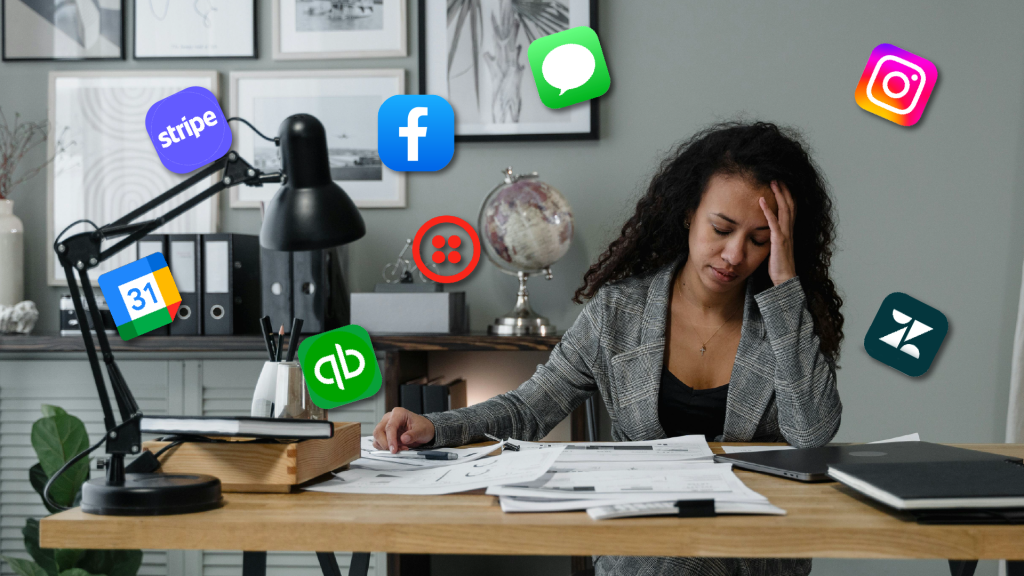
Too many businesses are still living in copy-and-paste worlds. The same customer data gets typed into multiple systems. The same status update gets repeated across text, email, CRM, calendar, support, invoicing, and internal notes. Teams chase context across fragmented tools. People become human middleware between disconnected systems. Growth gets slowed down by admin, and accuracy gets punished by repetition.
That’s not just a technology problem. It’s a focus problem.
Entrepreneurs should be spending more time on growth, relationships, creativity, judgment, and the human parts of business that actually differentiate them. Instead, many are trapped doing clerical work for the software they pay for.
Intuit’s 2026 benchmark report notes, many leaders feel stuck between tools that are too limited and legacy systems that are too complex. 42% of leaders rank technology investment as their top growth priority, but 24% say technology and security are their single biggest unmet need. The report’s advice? Fix the breakpoints slowing operations today, including manual consolidations, disconnected systems, and spreadsheet-based forecasting, before complexity compounds. (Intuit Digital Asset)
That’s the trap SMBs are in.
Back to National Small Business Week
The smaller the business, the more hats the entrepreneur wears.
Every additional hat creates more room for a knowledge gap.
Technology. Marketing. Accounting. Hiring. Customer service. Operations. And now, AI.
We can all learn almost anything now. But every hour spent trying to become an expert in a new category is an hour stolen from the work that makes the business special (and successful) in the first place.
This gets lost in the AI conversation. The issue isn’t whether small businesses are capable of learning. The issue is what they must stop doing in order to make time for that learning.
National Small Business Week celebrates our entrepreneurial hustle. But we recognize that hustle has a cost. And that better systems will lower it.
What SMBs Deserve
We deserve more than fragmented software and a thousand disconnected dashboards.
We deserve the kind of visibility, coordination, and automation that larger companies spend millions trying to buy, plus cleaner data, faster answers, and tools that make action easier -instead of harder. We deserve systems that do not require an IT Team just to become useful. We deserve AI without a PhD in prompt engineering. We deserve technology that respects our time.
And we deserve all of it without losing the humanity at the center of our business.
We’re not behind because we’re lazy or late. We fall behind because succeeding still takes real human hustle. And that hustle should be reserved for the human art that makes a business unique: relationships, taste, judgment, innovation, service, trust, creativity, leadership.
If business were only a numbers game, maybe we could all retire and hand it to AI.
But anyone actually in the arena knows better.
Let AI do what AI is good at. Let it help with the numbers, the automation, the support, some marketing, pattern recognition, and the cross-functional view. But keep the humanity where it belongs: at the heart of each business.
Why We Built BOSS.Tech
We built BOSS.Tech to reduce the learning curve, not add to it.
We built it because the future should not belong only to the companies with big IT Teams, giant budgets, and endless implementation cycles. It should belong to everyone willing to build a business, serve a customer, create value, and keep going.
AI can be a positive force. I believe that.
But only if we stop treating access like adoption, and adoption like success.
The next divide isn’t about who uses AI. It’s about who can actually use it in the flow of real work, in a real business, without breaking everything else.
That gap is widening.
It is time to change that.
At BOSS.Tech, our Mission isn’t to add more software to the pile. Our Mission is to exponentially improve the likelihood of success of every business we engage. Yes, with AI, but more importantly, with systems that honor the irreplaceable spirit of the entrepreneurs who create our economy.
Digital transformation left a lot of businesses behind. AI is increasing that gap for many -faster. It’s time to change that.