Sally Quiros

SMS Marketing in 2026. What It Is. How It Works. And Why It Is Still One of the Most Powerful Channels

SMS Marketing in 2026. What It Is. How It Works. And Why It Is Still One of the Most Powerful Channels If you run a business in 2026, you have already experienced SMS marketing. Maybe you opted in for an exclusive discount, confirmed an appointment, or tracked a delivery straight from a text. SMS has remained one of the fastest, simplest and highest performing ways to reach customers on the device they check constantly. The surprising part is not that SMS works. It is that SMS still works better than almost everything else.While inboxes get crowded, notification centers overflow and algorithms shift daily, SMS continues to cut through. It is direct. It is personal. It is immediate. And in a business world where attention is the new scarcity, simplicity wins. If SMS is not already part of your communication strategy, this is the moment to integrate it. Below is a clear breakdown of what SMS marketing actually is, how it works today and why it continues to dominate in 2026. You will also see why pairing SMS with automation platforms like BOSS.Tech gives businesses a structural advantage in a connected economy. What Is SMS Marketing SMS marketing is permission-based, direct communication sent to customers who have opted in to receive promotional, transactional, or informational messages from a business. Brands use SMS to: Announce flash salesConfirm appointmentsShare order updatesSend loyalty rewardsDeliver reminders and alerts Because it is permission-based, SMS marketing is regulated. Companies must obtain explicit consent before sending messages and must include a clear opt-out option in every communication. This protects both the customer relationship and the integrity of the channel. How SMS Marketing Works Here is the modern breakdown. Customers opt inBusinesses collect mobile numbers through website forms, in-store signups, QR codes, checkout pages, events or lead magnets. A business uses an SMS platform to build and automate communication Through platforms like BOSS.Tech, companies can:Schedule messagesPersonalize contentCreate templatesAutomate follow-upsTrack analyticsTrigger SMS from other tools Messages are delivered instantly and customers engage Customers can click, reply, confirm, update, or purchase directly from their phone. SMS supports action, not just awareness. Compliance is built in Companies must follow standards like TCPA, CTIA, and regional privacy regulations. Modern platforms automate compliance so businesses can communicate confidently. Why SMS Marketing Is Still So Popular in 2026 1. Exceptionally high open rates Texts reach open rates near ninety-eight percent. People read them within minutes. No inbox. No algorithm. No competition for attention. 2. Highly targeted messaging Businesses can segment audiences by behavior, purchase history, interests or location to deliver messages at the right moment, with the right context. 3. Cost-effective with strong ROI SMS requires almost no production overhead. Automation allows a single sequence to reach thousands instantly, saving time and budget. 4. Personalization that feels real Using names, past actions or relevant offers increases trust and engagement. Automated does not mean generic. 5. Universal accessibility SMS works on every phone with a signal. No app required. This gives businesses access to audiences that email and social media often miss. 6. Fully measurable performance Modern SMS platforms track: Click-through ratesConversionsOpt outsCampaign ROI This allows continuous optimization and smarter messaging over time. 7. Clear and simple compliance The rules are easy. Get permission. Deliver value. Offer an opt out. Following them builds long term trust with customers.   Where SMS Is Heading in 2026 and Why Automation Matters SMS is evolving into a central decision and coordination layer for modern businesses. AI-powered personalization, automated message flows, and cross-platform syncing make SMS more than a marketing tool. It becomes the connective tissue between communication, operations and customer experience. Businesses that integrate SMS inside automation platforms like BOSS.Tech can route updates, reminders, notifications, follow ups and workflows through one unified system. SMS triggers tasks, supports payments, updates customers and completes loops instantly. This is the connected company.Fast communication that moves with the business, not behind it.If SMS is not part of your 2026 strategy, you are leaving attention, engagement and revenue unused. Ready To Upgrade Your SMS Marketing BOSS.Tech helps businesses move from manual messaging to effortless, automated communication. You can: Build automated SMS campaignsPersonalize every messageTrack real-time performanceSync SMS with email, CRM, calendar, and paymentsSimplify compliance with built-in opt-in and opt-out Download BOSS.Tech and take your SMS strategy to the next level. Your communication gets faster. Your team gets clearer. Your business gets easier.

SMS Marketing in 2026. What It Is. How It Works. And Why It Is Still One of the Most Powerful Channels Read More »

Your Business, in Your Pocket. Why Mobile-First Workflows Are Redefining How SMBs Operate

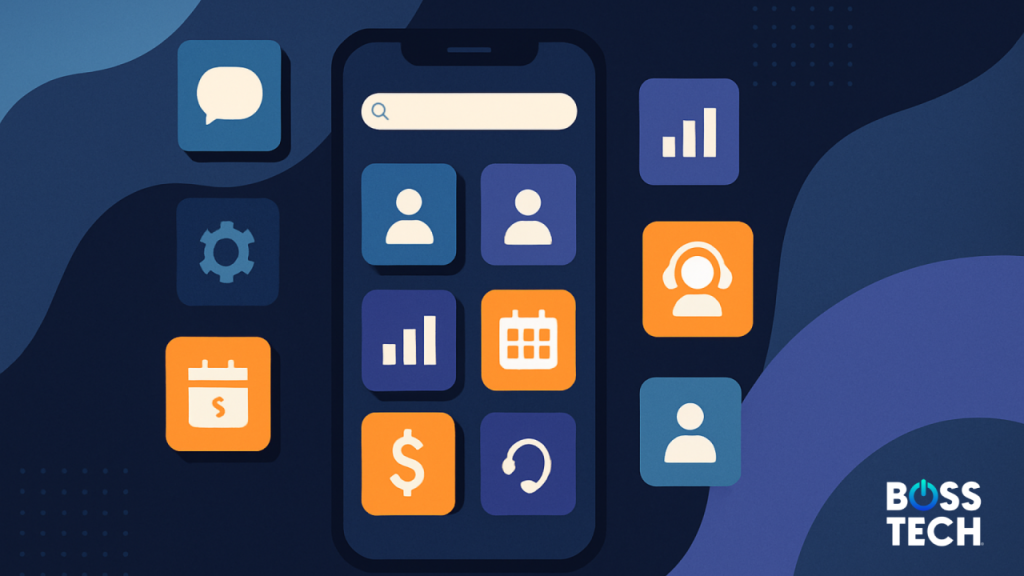
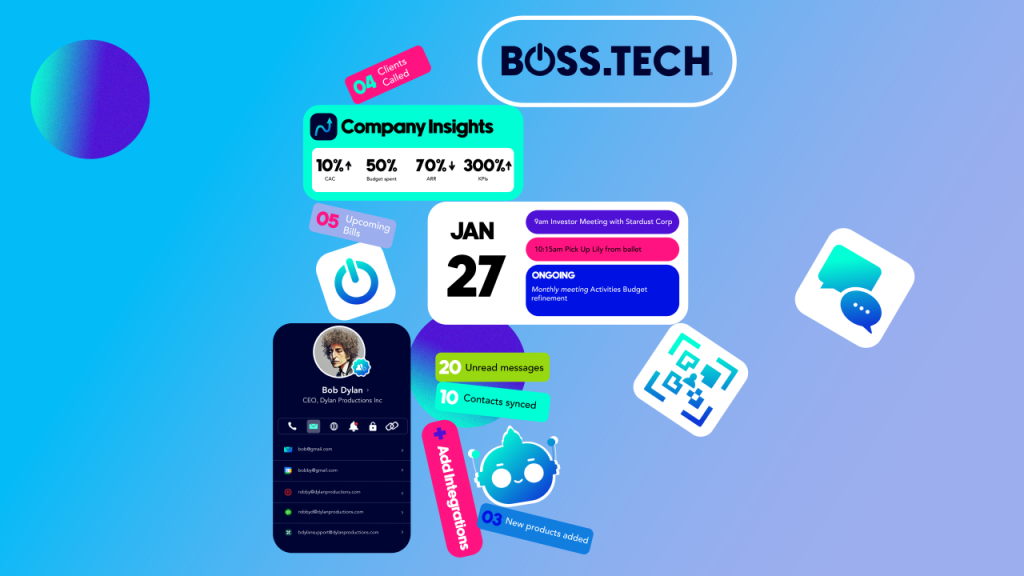
Your Business, in Your Pocket. Why Mobile-First Workflows Are Redefining How SMBs Operate The idea of “going to work” once meant returning to a specific place with a specific setup. A desk. A chair. A computer waiting for you before anything could move forward. That world is gone, replaced by a reality where founders run entire companies from the same device they use to navigate their day. What started as a temporary adaptation has become the new baseline for how business gets done. Modern business demands speed. It demands clarity. It demands action at the moment something happens, not later when you finally sit down at a laptop. SMBs are no longer competing based on who works the hardest. They are competing based on who removes the most friction. In a landscape where everything moves in real time, mobile-first is not a preference. It is the new operating standard. The challenge is that most business owners already rely on their phones, yet their workflows remain scattered. Messages sit in one app, invoices are buried in another, scheduling floats somewhere else, and analytics hide behind separate logins. Every tool promises productivity, but together they create fragmentation. You switch apps, lose context, and slow down decisions that should take seconds. The problem is not lack of software. The problem is that work gets scattered across it. Business owners do not want more apps. They want one connected place where communication, clients, tasks, payments, insights, and follow ups flow together without hunting for information. When your workflow is connected, mobile stops being a backup plan and becomes the command center for your entire business. Decisions happen faster. Responses come with full context. Teams move without pause. Visibility becomes something you carry in your hand instead of something you wait to access. This is the shift leveling the playing field. The agility once reserved for large enterprises with full departments and complex stacks is now accessible to every business owner with a phone. BOSS.Tech was built for this new reality. Not as a desktop platform that happens to work on mobile, but as a SuperApp designed for founders who live and work in motion. Communication, clients, analytics, payments, tasks, proposals, scheduling, and team operations all live in one connected workspace. Your phone and laptop show the same universe of information. Nothing is siloed. Nothing is lost. People Sync keeps your contacts unified across every action, so reminders, invoices, messages, and meetings stay attached to the right person without manual effort. Insights adds the intelligence layer that SMBs have never truly had. It interprets behavior, surfaces patterns, and shows opportunities from the same place where work already happens. It becomes the source of clarity you carry with you everywhere. This is not mobile as an accessory. This is mobile as the operating system for your business. The next generation of successful SMBs will not be defined by how quickly they can type on a laptop. They will be defined by how seamlessly they can run their companies from wherever they are. Mobility has become the foundation of modern productivity, and connected workflows are becoming the difference between moving quickly and falling behind. BOSS.Tech gives founders the ability to run their companies with the same simplicity they use to check their phones. Always connected, always informed, always ready to act. Your business moves with you now, and with BOSS.Tech it never slows down. Download BOSS.Tech

Your Business, in Your Pocket. Why Mobile-First Workflows Are Redefining How SMBs Operate Read More »

The Rise of the Connected Company: Why Data Alone Isn’t Power Anymore

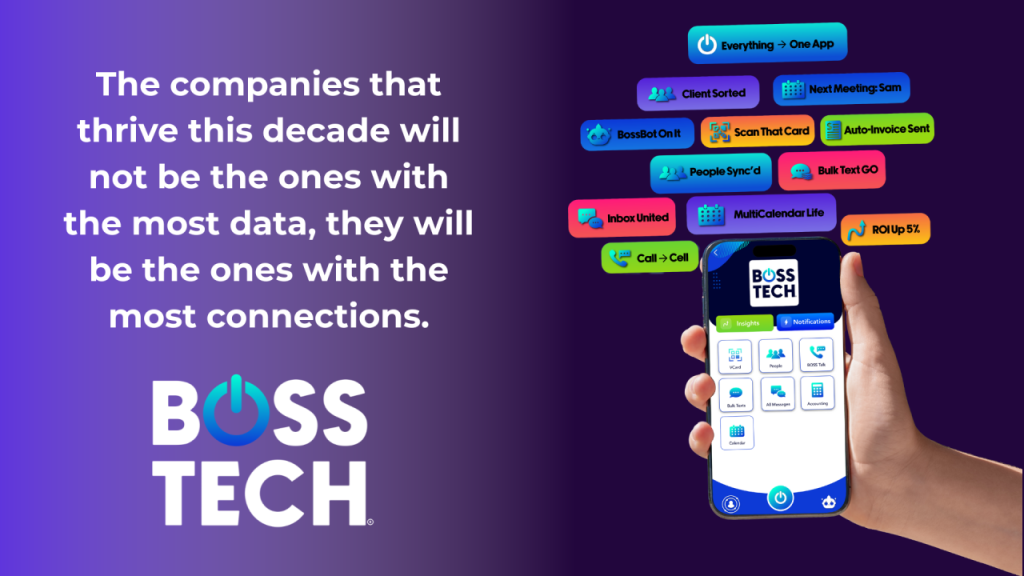
The Rise of the Connected Company: Why Data Alone Isn’t Power Anymore For years, “data is power” was the mantra of modern business. Companies raced to collect it: clicks, sales, conversations, surveys, behaviors. More dashboards. More metrics. More everything. And for a while, that worked. Data became the new oil, the ultimate advantage, the hidden engine behind every major decision. But then something changed. Everyone got the oil. Everyone got the dashboards. Everyone got the noise. Data stopped being scarce. What is scarce now is connection. The ability to make data mean something across people, tools, and moments. Businesses have never had more access to information, yet most leaders still make decisions half blind. The problem is not a lack of data but a lack of context. Information lives in silos: sales in one app, customer messages in another, invoices somewhere else, and team updates lost in a thread. We think we have visibility, but what we really have are fragments. A founder opens one tab to check overdue invoices, another to message a client, another to schedule a meeting, and still never sees the full story of that relationship. Disconnected data creates disconnected work. Teams operate on assumptions, repeat tasks, and miss opportunities because their systems never connect. The next era of business is not about collecting more information. It is about connecting what we already have. At BOSS.Tech, we call this shift the rise of the Connected Company. A Connected Company runs on intelligence that moves. When a client books a meeting, the accounting system knows it. When a payment is late, the calendar and messages know it. When a customer opens an invoice, the right people already have the context to act. This is not about more data. It is about data that travels across systems, across teams, and across time. The heart of that transformation is People Sync. People Sync is the connective layer inside BOSS.Tech. It takes all those scattered bits of information—names, payments, messages, meetings—and links them into one clean, unified view. If your client shows up as Alex M in messages, Alexander Miller in invoices, and Alex from Accounting in your calendar, People Sync knows it is the same person. It merges the details, fills in the blanks, and shows what matters: the entire relationship. Before a meeting, you already know Alex owes an invoice, booked a follow-up for next week, and opened your last reminder yesterday. One view, one context, one clear understanding. That is the difference between data and connected data. One tells you what happened. The other tells you why it happened and what to do next. AI without context is prediction. Context turns prediction into precision. That is why the most forward-thinking companies are shifting their focus. They are no longer chasing volume. They are building intelligence that is aware, linked, and useful. Because businesses rarely fail for lack of information anymore. They fail for lack of alignment. The companies that thrive this decade will not be the ones with the most data. They will be the ones with the most connection. Data alone is static. Connected data moves. It informs, adapts, and acts. It gives AI direction and teams purpose. It transforms clutter into clarity. That is the power of BOSS.Tech. Not another tool in the stack, but an operating system that connects everything already in it. People Sync ties it together. BOSS Bot interprets what it means. The result is a business that runs with context instead of confusion. The Connected Company is not a theory or a future concept. It is happening now, built by founders who are tired of piecing together systems that never truly talk. They are not chasing more data. They are chasing meaning. And meaning comes from connection. Business. Easier. https://boss.tech/

The Rise of the Connected Company: Why Data Alone Isn’t Power Anymore Read More »

The Quiet Rebellion Against Hustle Software

The Quiet Rebellion Against Hustle Software Somewhere between your eleventh Chrome tab and your fourth productivity app, you realize you have built a full-time job just managing your tools. Every click feels familiar. You open one platform to track leads, another to send invoices, another to schedule, another to message. Your “efficiency stack” has quietly become a digital maze. These tools promised to make work easier, but they ended up turning work into maintenance. There’s a modern myth in business that the most successful founders are the ones doing the most. More dashboards. More data. More notifications. But being busy is not the same as building. We have glamorized grind mode and turned constant motion into a badge of honor. Somewhere along the way, we decided that the more platforms we use, the more legitimate our business looks. Yet every new tool adds setup, maintenance, and mental clutter. The more apps you add, the less productive you actually become. Context switching kills focus. Over-automation kills creativity. The founder who wanted freedom ends up managing a dozen disconnected systems that refuse to talk to each other. Most small business owners now use ten or more different tools every day. Almost half say that “integration chaos” is their biggest barrier to scaling. The industry’s answer to that problem is usually another app. Another promise of simplicity. Another login. We’ve reached the point where people are optimizing their tools more than their actual work. Productivity software has become the new distraction. You don’t need another AI-powered to-do list. You need a system that knows when to stop adding to your list. Something is shifting. It isn’t loud, but it’s happening everywhere. Founders are deleting apps instead of adding them. Teams are saying no to metrics that measure motion instead of meaning. Freelancers are trading “move fast and break things” for “move smart and sync everything.” This quiet rebellion against hustle software looks like business owners who prefer one calm dashboard over five chaotic ones. It looks like teams who value clarity more than constant activity. It looks like people who believe that rest is not laziness, but part of a better system. The rebellion is about reclaiming time and control. It’s about choosing tools that think with you, not just for you. The future of work isn’t about speed. It’s about intelligence. A real business system doesn’t just collect data. It connects it. It syncs clients, money, time, and communication so that everything flows together. That’s what BOSS.Tech was built for. Instead of juggling multiple apps, BOSS.Tech acts as a Business Operating System. One platform that brings the essentials of running a company into a single connected experience. People Sync keeps your contacts unified across every tool. Whether they show up as Alex, Alexander, or “that guy from accounting,” you always see the full picture — from unpaid invoices to upcoming meetings. BossBot turns AI into your operational partner. It highlights what matters: a client payment due tomorrow, a meeting that needs prep, a quick insight that keeps your day on track. Accounting and Calendar work together so your money and time finally speak the same language. This isn’t automation for the sake of automation. It’s business intelligence designed to make you breathe easier. No one actually wants to grind forever. What people want is a business that runs smoothly, makes sense, and leaves space to think. Success today isn’t about doing everything. It’s about doing the right things well. The new generation of founders doesn’t brag about working fourteen-hour days. They brag about how calm their workflow feels. They measure success by focus and flow, not exhaustion. Maybe it’s time to retire “hustle harder” and replace it with something better: work cleaner, sync smarter, lead clearer. Because business doesn’t need to feel chaotic. It can feel easy. It can feel connected. It can feel like BOSS.Tech. If you’re ready to stop juggling platforms and start running your business the way it was meant to run, it’s time to join the quiet rebellion. One login. One system. One big exhale. Business. Easier. Learn more at boss.tech

The Quiet Rebellion Against Hustle Software Read More »

SuperApps: The Future of Digital Experience Is Modular, Mobile, and Composable

SuperApps: The Future of Digital Experience Is Modular, Mobile, and Composable Imagine opening a single app on your phone that replaces your banking app, your team chat tool, your calendar, your task manager, and even your customer service portal, all without ever visiting another app store. Welcome to the world of SuperApps. What Is a SuperApp? Coined from the likes of WeChat and Grab, a SuperApp is a mobile-first platform that provides a core set of features along with access to a growing ecosystem of MiniApps. Think of them like plug-ins or microservices users can activate, customize, and remove at will. These aren’t just bundled apps. SuperApps are intentionally designed to support composable digital experiences, where users, developers, and organizations can shape the platform to their specific needs. It’s like carrying a Swiss army knife -one where you decide which tools it holds. Why SuperApps Are Gaining Momentum According to Gartner, by 2027 more than half of the global population will use multiple SuperApps every day. Why now? Mobile-Native Expectations: Gen Z and younger Millennials have grown up in an app-saturated world. They expect unified, elegant, on-demand mobile experiences that don’t require app-switching or juggling multiple logins. Composable Business Strategies: Enterprises are moving toward composable architectures -loosely coupled systems that allow fast assembly and reconfiguration. SuperApps are the front-end expression of this movement, enabling agility without sacrificing consistency. Data-Driven Personalization: SuperApps centralize authentication, permissions, and preferences. This enables cross-app personalization without requiring users to re-input data or preferences over and over. Platform Economies of Scale: Much like app stores, SuperApps benefit from ecosystems. Internal teams and third-party developers can co-create MiniApps, extending the platform’s value exponentially. How SuperApps Actually Work Think of a SuperApp as a container. It has its own capabilities — like messaging, search, or dashboards, but also supports an ecosystem of MiniApps. These MiniApps might handle: Submitting an expense report Booking a client call Updating a customer profile Viewing key metrics from multiple SaaS tools Importantly, users don’t need to leave the SuperApp environment. They browse and activate MiniApps directly within the platform. There’s no separate marketplace, no external login, and no learning curve beyond the core UX. For developers, modern tools like low-code platforms, MXDPs (multiexperience development platforms), and PaaS solutions make it easier than ever to build, deploy, and maintain MiniApps. Enterprise Use Cases: Customers and Employees Alike While many SuperApps began in consumer fintech (e.g., PayTM, Revolut), the model is quickly moving into the enterprise. For Customers: A single app to manage all services across a brand Personalized offers, support, and services -without app-switching Consistency in design and security, even across different service types For Employees: Access to HR, IT, CRM, and productivity tools in one interface Reduced onboarding time and context-switching Real-time insights, messaging, and approvals from a unified workspace This centralization improves UX, reduces tool sprawl, and supports data normalization, a key step toward better decision-making with AI. The Challenge: It’s Not Just Technology, It’s Ecosystem The biggest hurdle isn’t building the tech, it’s building the ecosystem. MiniApps need consistent design, shared authentication, and cooperative data policies. Internal silos and inconsistent standards can limit a SuperApp’s effectiveness. Similarly, overloading a SuperApp with too many disjointed MiniApps can confuse users rather than streamline experiences. A successful SuperApp strategy requires more than APIs and SDKs — it requires cultural alignment across teams and partners. The Bottom Line: SuperApps Aren’t Just an App Trend — They’re a Platform Shift Gartner’s insights are more than trendspotting. SuperApps signal a paradigm shift in how we think about digital experiences -from fragmented apps toward unified, modular, and personalized ecosystems. This isn’t about building a bigger app. It’s about building a better way to work, collaborate, and serve, whether you’re a global enterprise or a growing business ready to leap ahead.

SuperApps: The Future of Digital Experience Is Modular, Mobile, and Composable Read More »

Business isn’t a solo endeavor. It’s a Team Sport

Business isn’t a solo endeavor. It’s a Team Sport Running a business shouldn’t feel like you’re playing every position on the field at once. But for too many founders, that’s the reality: you’re the quarterback chasing sales, the linebacker blocking overdue invoices, the wide receiver trying to keep calendars aligned, and the equipment manager making sure all the tools (apps) even show up on game day. By halftime, you’re exhausted — not because of the big plays, but because of all the scattered, thankless tasks. The truth? Founders don’t fail because of lack of ideas, grit, or hustle. They fail because their energy gets drained by playing every role at once. At BOSS.Tech, we don’t believe founders need more apps. We believe they need a better team. A pro sports team works because every player has a role. They know the playbook. They communicate in real time. And they make each other better by being connected, fast, and focused on the same goal. That’s exactly how we’ve built BOSS.Tech: a Business SuperApp that takes on the heavy lifting across your company so you can stay captain, not equipment manager. Accounting that syncs with your calendar → so before you even step into a meeting, you know who owes you. Messages, emails, and reminders in one place → no more juggling inboxes and platforms to stay on top of clients. AI prompts that run plays for you → from invoices to event reminders, the grunt work is automated before you even think about it. People Sync → your roster manager. Whether “Alex” shows up as Alex in your messages, Alexander in accounting, or A. Smith in your calendar, People Sync knows they’re the same player. No mix-ups, no gaps. When your business tools work in silos, it’s like lining up a team of star athletes but never giving them the same playbook. When they work together, you get flow, rhythm, and wins that compound. That’s why our culture at BOSS.Tech mirrors the product itself. We’re less like a family and more like a high-performance crew — where every role matters, every player earns their spot, and the mission comes first. We believe the goal isn’t perfection. It’s progress. And progress comes faster when the right players are in sync. Business isn’t about trying to run every play alone. It’s about building a team — human and digital — that frees you up to focus on the end zone. Because when your team is built right, business gets easier. And that’s the point. Business. Easier.

Business isn’t a solo endeavor. It’s a Team Sport Read More »

SMBs, AI, and the Future of Accessible Innovation

SMBs, AI, and the Future of Accessible Innovation When Brian Halligan, the CoFounder of HubSpot, Jason M. Lemkin,Rory O’Driscoll, and Harry Stebbings get together, the insights flow fast. Their recent conversation touched on one of the most important tensions in tech today: how to build AI-powered products for small and mid-sized businesses (SMBs). SMBs as “Anti-Consensus” Bets As Brian shared, focusing on SMBs was deeply counter-consensus in Silicon Valley. At the time, investors and Founders alike dismissed SMBs as “too small,” “too fragmented,” and “too hard to serve.” Yet companies like HubSpot, Shopify, Monday.com, and others proved that the anti-consensus path can create tens of billions in enterprise value. The lesson? Great companies often come from serving the overlooked. Where others see risk, bold Founders see opportunity. Why AI for SMBs Feels Different But here’s the rub: as Jason Lemkin pointed out, many AI products require training, customization, and ongoing orchestration, something SMBs just can’t dedicate resources to. Unlike enterprises with full AI teams, most SMBs are run by owners juggling payroll, customers, and survival. They don’t have time to “train the AI.” That’s why today’s AI landscape feels polarized: Prosumer tools like Canva, Gamma, and Replit thrive with intuitive, lightweight adoption. Enterprise deployments like  Palantir work with deep customization and teams. The middle ground, AI for SMBs, is still unsolved. Cracking the Code: Pre-Trained, Pre-Packaged, Plug-and-Play Rory O’Driscoll offered a hopeful take: SMBs eventually adopt what enterprises already define, but only once it’s packaged tightly and priced simply. Think phone-answering AIs, order dispatch bots, or pre-trained customer service agents. The SMB version can’t require a year-long rollout; it has to work in minutes, not months. That’s the opportunity: whoever can deliver AI “value without the overhead” will win the SMB market. My Take: Why SMB AI Matters More Than Ever I couldn’t agree more. The small business owner is the backbone of the economy, but they’ve long been underserved by technology. AI offers them leverage they’ve never had before, if it’s delivered right. The winning formula will be: Pre-trained AI agents that come “out of the box” ready to work. Consumer-grade simplicity (think: no manuals). Affordable, modular pricing so SMBs can adopt incrementally. Immediate ROI in hours saved and customers served. This isn’t just a market opportunity, it’s our mission. The same way HubSpot pioneered inbound marketing for SMBs, the next wave of innovation will pioneer agentic AI for SMBs. And history tells us: betting on SMBs is still the best “anti-consensus” move you can make. – Felicite Moorman

SMBs, AI, and the Future of Accessible Innovation Read More »

Hybrid Leadership in 2025: How to Build Culture Without Borders

Hybrid Leadership in 2025: How to Build Culture Without Borders Work isn’t what it used to be. Before 2020, offices were the default—deadlines got met over coffee chats and water-cooler pep talks. Then COVID forced a hard pivot to fully remote work—new tools, new norms, new pace. Now, some leaders are calling employees back in full-time, while others, like us at BOSS.Tech, have discovered the sweet spot: hybrid. For us, it’s not just flexible—it’s the most effective way to stay connected, inspired, and productive. With BOSS.Tech, hybrid leadership is seamless. Our platform is the only Business Operating System SuperApp, uniting all your business tools—ticketing, tasks, messaging (DMs, texts, emails), invoicing, scheduling, and more—into a single, AI-powered mobile hub. You can manage your entire business workflow—no laptop required—anywhere, anytime. Here’s how to lead successfully in a hybrid world. 1. Shift from Presence to Performance Hybrid work demands a shift from “managing time” to “managing impact.” Use clear goals and dashboards to make progress transparent and accountability automatic. Focus on regular, meaningful updates that move projects forward, rather than constant interruptions. 3. Build Culture Without a Watercooler Hybrid teams don’t need more messages—they need clarity and context. Synchronous chat for nuanced conversations. Asynchronous messaging for updates and brainstorming—respecting time zones and deep work. Avoid meeting overload with defined agendas and priorities. What a Real Business SuperApp Must Deliver Culture is less about proximity and more about belonging. Host virtual coffee chats, celebrate milestones, and lean into small rituals. Promote cross-team collaboration to spark connection and creativity. When you are in the office, use it intentionally—grab lunch with teammates, brainstorm face-to-face, or celebrate wins in person. Those moments can deepen bonds faster than a dozen Zoom calls. 4. Equip Yourself With the Right Toolkit The hybrid leader’s toolkit is digital-first and human-centered. Project management, collaboration, and appreciation tools are non-negotiable. Emotional intelligence, empathy, and adaptability are even more critical now. 5. Future-Proof Your Team The hybrid world is still evolving—your leadership should too. Use AI to automate repetitive tasks. Invest in learning, upskilling, and team well-being. Monitor performance and morale in real time. Making Hybrid Work with BOSS.Tech Leading in a hybrid environment is simpler when your business lives in one connected hub. BOSS.Tech is the first Business Operating System SuperApp, designed to bring all your tools into one AI-powered mobile workspace. With BOSS.Tech, you can: Run your business entirely from your phone—no laptop required (unless you want to). Have every messaging channel (DMs, emails, texts) in one place, connected to tasks, projects, and documents. Access every part of your business in real time—from sales and support to finance and marketing—so you can make decisions instantly. Keep your team aligned, whether they’re across the hall or across the world. Hybrid isn’t compromise—it’s choice. It gives your team freedom and you clarity. And when your office fits in your pocket, leadership becomes lighter, smarter, and infinitely more mobile. That’s hybrid done the BOSS.Tech way.

Hybrid Leadership in 2025: How to Build Culture Without Borders Read More »

The Rise of the Business SuperApp: Lessons from Consumer Tech

The Rise of the Business SuperApp: Lessons from Consumer Tech In China, one app can help you chat with friends, book a doctor’s appointment, pay your bills, order lunch, and run your business without switching screens. Southeast Asia has Grab. India has Paytm. For years, the West has watched these “SuperApps” reshape daily life. We’ve been curious, impressed, and maybe even a little skeptical. But the SuperApp wave is about to hit business, and it is going to change how companies operate. From Consumer Habit to Business Potential SuperApps began as one-stop digital hubs. Need to message someone? Book a ride? Pay a vendor? You could do it all in one place. In countries like China, WeChat became more than a social platform — it became digital infrastructure. Grab in Southeast Asia and Paytm in India followed the same path, embedding payments, communication, commerce, and services into one seamless ecosystem. They didn’t just catch on, they became part of daily life. The reasons are clear: mobile-first adoption, payments integrated from the start, and loyalty built through pure convenience. The same logic that made SuperApps essential for daily life applies to running a company. We all want integration, convenience, and one source of truth. Why the U.S. Hasn’t Gotten There Yet The average small-to-midsize business in the U.S. now runs over 100 different SaaS tools. That’s 100 logins, 100 interfaces, 100 support channels, and 100 separate pockets of data. Every time you switch between apps, you lose focus. Studies show context switching can eat up 40% of productive time in a day — the equivalent of only getting three days of work out of a five-day week. So why hasn’t the U.S. embraced a business SuperApp? Partly because of our fragmented SaaS culture, where every niche has its own “best tool” that doesn’t connect with the others. Privacy and compliance rules add complexity. And many companies still cling to the “best-in-breed” approach, even when it slows them down. But the ground is shifting. AI is now capable of connecting, interpreting, and acting across systems. Even the smallest businesses are digital-first. And with economic pressure pushing companies to consolidate, efficiency is no longer a nice-to-have — it’s survival. What a Real Business SuperApp Must Deliver A true Business SuperApp is not just about putting more features in one place. It’s about connected intelligence, where every part of your operation shares data and context in real time. That means: Unified data so every contact, transaction, and message is linked and current AI that goes beyond answering questions to recommending strategic moves Flexibility to adapt to any industry or company size Security and compliance built in from the start Core functions — messaging, payments, scheduling, analytics — all speaking the same language Think of it as your company’s headquarters in your pocket. The Next Decade In every major tech shift, a few leaders emerge. The companies that move early toward consolidated, intelligent operations will have the speed, agility, and insight to pull ahead. Those that stick with tool sprawl will spend more time managing software than managing their business. We’ve seen consumers embrace all-in-one apps for over a decade. Now it’s business’s turn. The companies that recognize this shift today will shape the way we all work tomorrow. When your tools work together, your team can too. Maybe BOSS.Tech: The Business SuperApp you’ve been waiting for This is exactly where BOSS.Tech comes in. We’ve built the platform to solve the integration, fragmentation, and efficiency problems holding businesses back in everywhere and beyond. Our goal is simple — give companies the power of a true SuperApp, designed for businesses by businesses. BOSS.Tech connects your most critical tools, synchronizes your data in real time, and uses AI to recommend your next move before you have to ask. It’s not about adding “more apps” into one screen — it’s about creating a single, intelligent system that works for you, not the other way around. If WeChat changed the way consumers live in Asia, BOSS.Tech is here to change the way businesses run…everywhere. 

The Rise of the Business SuperApp: Lessons from Consumer Tech Read More »

The Death of App Overload: How One SuperApp Can Run Your Entire Business

The Death of App Overload: How One SuperApp Can Run Your Entire Business If your team’s productivity is trapped in a sea of tabs, it’s time to rethink your tech stack. The problem: app overload is real (and expensive) The average company now runs ~100+ apps—Okta pegs it at 101 this year, the first time it’s crossed the triple‑digit mark, reflecting a 9% YoY jump.  Even with some consolidation, BetterCloud still sees ~106 SaaS apps per org on average in 2025.  As stacks balloon, control fragments. In Zylo’s 2025 index, IT owns just 26% of SaaS spend and 16% of apps; the rest is purchased by lines of business—exactly how duplication and shadow IT creep in.  And the hidden tax? Context switching. Deloitte notes it takes ~23 minutes to regain focus after a disruption; Atlassian shows it can take up to 9.5 minutes just to get back into a workflow after hopping apps. Multiply that across a day and you’re staring at double‑digit percentage losses in productive time.  Why superapps are winning Consumers already live in superapps (WeChat, Grab). Analysts expect the global superapp market to grow at ~24–28% CAGR through the next decade, signaling a clear shift toward unified, mobile-first hubs.  For businesses, the appeal is obvious: One hub, fewer tabs: cut duplicate tools and orphaned licenses. Unified identity and security: fewer surfaces to secure as app sprawl grows past 100 tools. Shared data model: reduce swivel‑chair work and manual exports. The trendline backs it up: companies are actively consolidating—BetterCloud reports consolidation slowed but continued in 2025, with 106 apps on average and a majority preferring unified platforms over point solutions.  How BOSS.Tech solves app overload BOSS.Tech brings your essential workflows into one customizable mobile app so teams can work faster with less friction. Integrations that actually integrate: Connect the tools you already use, then centralize the moments that matter (lead capture, scheduling, payments, comms). AI People Sync: Consolidates customer and partner data into a single, living profile—no more hunting across five systems. Industry‑ready templates: Start with flows tuned for your sector, then tailor without code. Governance by design: Reduce shadow tools with one secure entry point instead of a sprawl of logins. What this looks like in practice A 25‑person service firm we piloted consolidated from 9 apps to BOSS.Tech + 3 critical systems. Results in 60 days: Fewer logins and fewer duplicate records. Response times down as messages, invoices, and scheduling lived in one place. Happier ops team: less time chasing data and permissions (that 23‑minute focus tax adds up). The takeaway Your team doesn’t need another point tool; it needs one place to run the day. With stacks now averaging ~100+ apps, the biggest unlock isn’t “adding AI”—it’s reducing friction so AI and humans can actually work together.  VIP list Get early access to our launch, behind‑the‑scenes updates, and priority onboarding when slots open. → Join the VIP list (2 minutes, tops).

The Death of App Overload: How One SuperApp Can Run Your Entire Business Read More »